Showing posts with label Hiroshima. Show all posts

Thursday, August 8, 2024

Nagasaki Was The Worst -- Hear Me Out

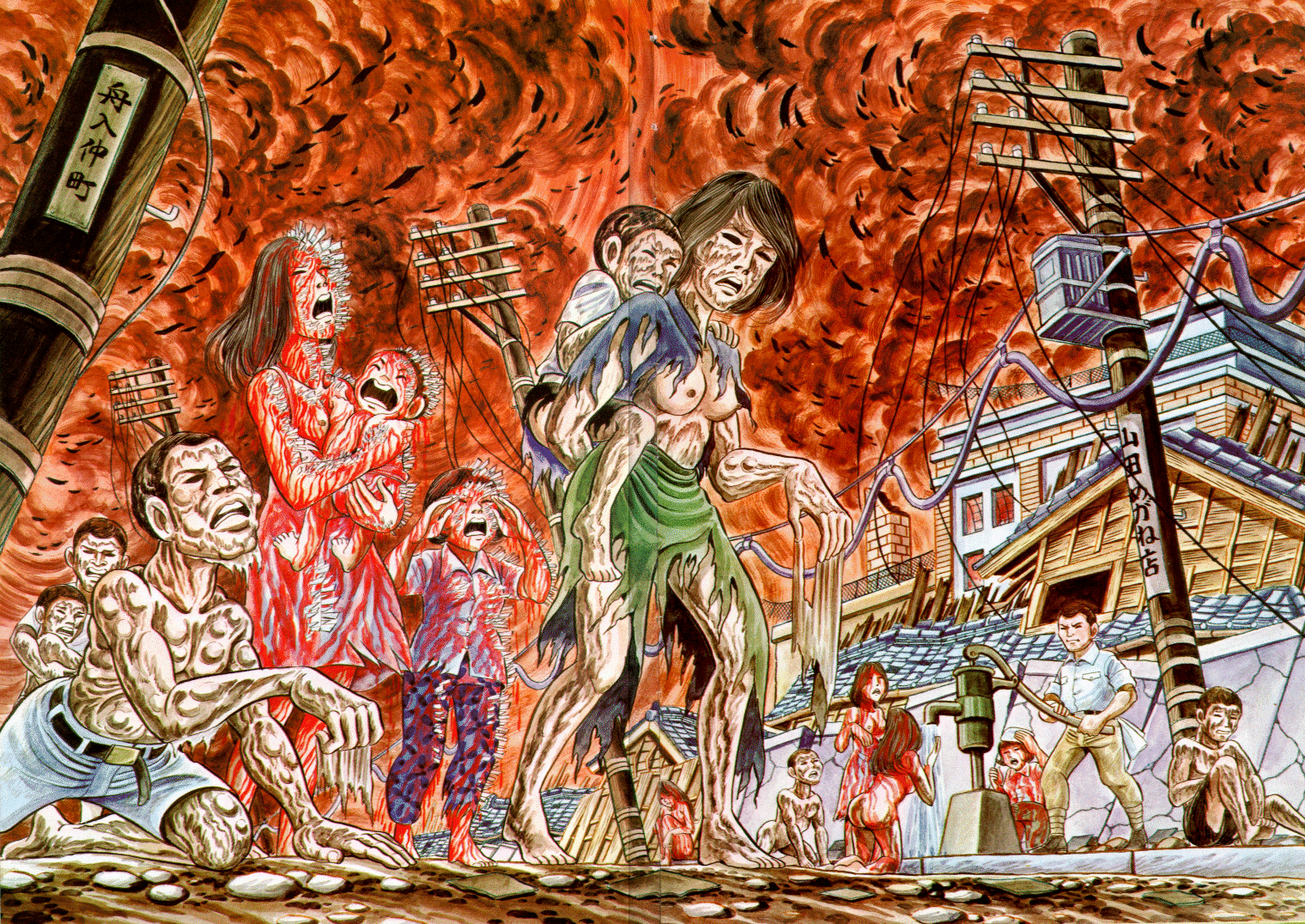
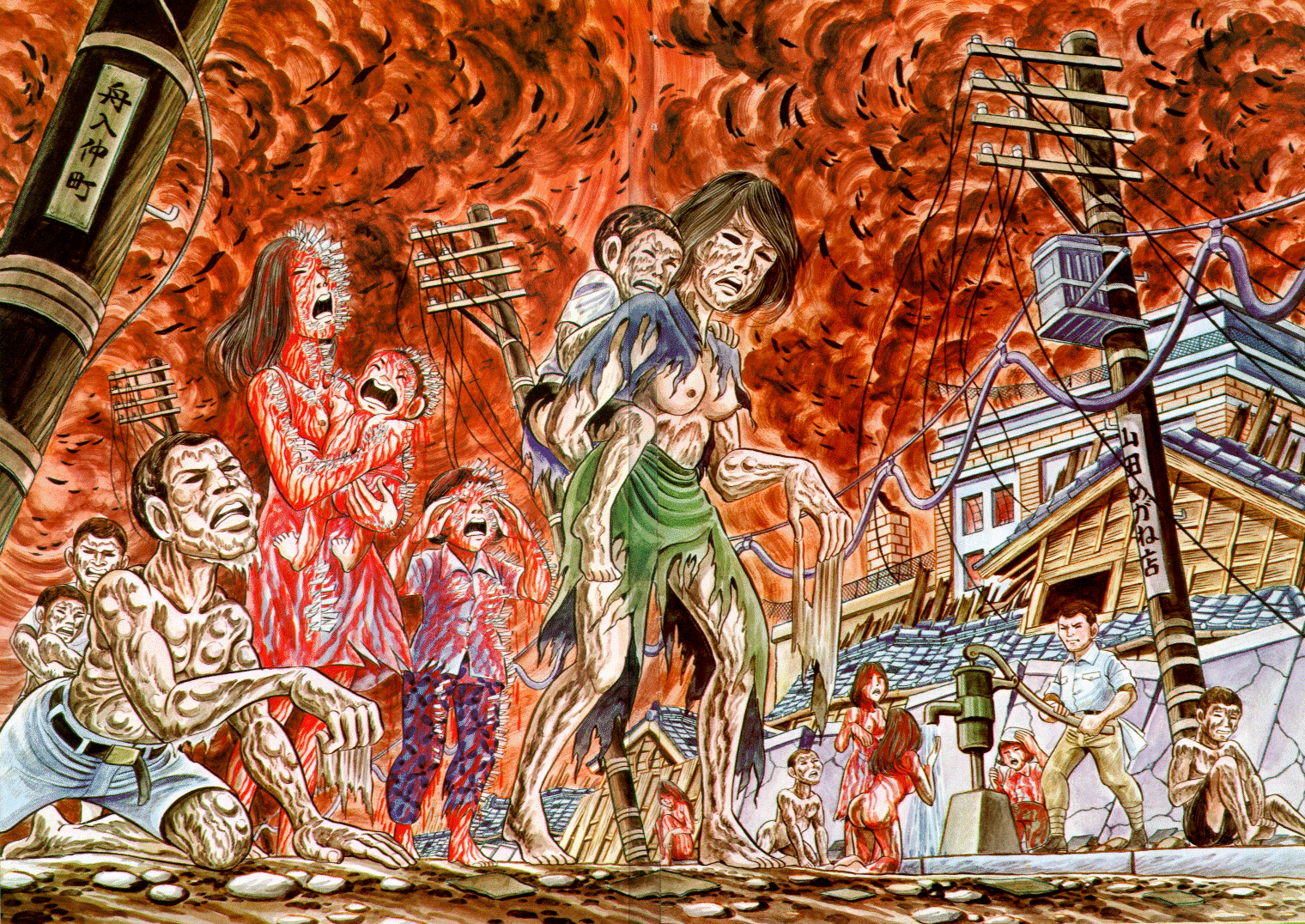
Caption* at the end of this post

U.S. bombing of the city of Nagasaki on August 9, just a few days after they had launched the world's first nuclear attack with a different kind of atomic bomb, was an even worse crime than bombing Hiroshima.

Hear me out.

These war crimes are always sold to the U.S. public as having been "necessary" to end WWII without an invasion of the Japanese mainland that was sure to cost the lives of many in the U.S. military. But the Japanese were already negotiating to surrender, and knew the war was lost for them. Some have speculated the U.S. went ahead anyway in order to both test the weapons, and intimidate their WWII ally the U.S.S.R. in a spectacular kick-off to what would become the Cold War.

U.S. citizens knew that some kind of catastrophic weapon had been deployed, and that the Japanese emperor soon surrendered, but it wasn't until John Hersey's long piece in the New Yorker in August, 1946 that many learned the gruesome details. Even then, the protracted suffering from radiation poisoning of the surviving hibakusha (a term that had to be coined) was largely unknown.


My own grandfather, drafted into WWII, was among the first U.S. troops to enter Nagasaki after the bomb. Despite pestering by his daughter (my mother), he would never talk about it. Thus the label, the "Silent Generation."

We of the baby boom generation have lived under the threat of nuclear annihilation our entire lives. We've watched in horror as nuclear weapons and energy have proliferated, despite the  Hiroshima-Nagasaki Protocol and many other efforts to have humans swear off nuclear before it is too late for everybody. 

When young people find out about the disaster visited on Hiroshima, they ask an essential question: Why did the U.S. drop an atomic bomb on the people of Hiroshima? I think this propaganda film made by the Army about Okinawa is a succinct explanation of the overall strategy, though it leaves out the build-up to Pearl Harbor engendered by blocking oil shipments to rapacious Imperial Japan.


Here's my argument for why Nagasaki was worse.

Place in JapanWhat U.S. citizens “know”
What I “know”
Hiroshima

広島市
Bombing it saved untold numbers of U.S. lives by making a ground invasion of Japan unnecessaryJapan was already negotiating for surrender, and had long since lost the war; their economy was so crushed that they were building kamikaze planes without landing gear in order to save yen; President Truman said: we have spent so much money building these weapons, we have to use them.
Nagasaki

長崎市
The Japanese still didn't surrender after Hiroshima, so we had to show them we weren't kidding.We were in too much of a rush to allow three days for Japan to react to Hiroshima with unconditional surrender; we were testing a completely different type of nuclear weapon; we were making an example of Japan so the Russians i.e. Soviets, the Chinese, and anybody else would think twice before challenging our power to destroy. 

In the 21st century the U.S. has been relentlessly hammering away at Japan's strong post-WWII stance on militarism. Article 9 of their constitution forbids any forces other than self-defense forces. But there are lots of ways to weasel around laws growing dusty on shelves.

Maybe you missed the news that Japan is now a big partner with NATO. Wait, you say, isn't that the North Atlantic Treaty Organization? Prime Minister Kishida Fumio can set you straight. According to Japan's news outlet NHK, "Kishida said the security environments of the Euro-Atlantic and Indo-Pacific regions are now inseparable."

Nagasaki has been in the news this week because Mayor Suzuki Shiro refused to invite Israel's ambassador to the commemoration ceremony. It appears that he was concerned that pro-Palestine protests -- which have been vigorous in Japan -- might disrupt the ceremony if Israel was represented there. In response to his decision, ambassadors from the UK, France, Australia, and the U.S. (the odious Rahm Emmanuel) announced they would boycott the ceremony.

Because why would the U.S. want to appear contrite and apologetic about one historical act of mass murder when they are actively engaging in genocide with Israel in Gaza?

Suzuki said August 9 is the most important day of the year for the city of Nagasaki. He said the average age of the atomic bomb survivors is over 85 and some of them will be attending the ceremony amid the severe heat.

He added, "After comprehensively considering the matter, including the risk that an unexpected situation may arise, I made the decision to refrain from inviting the Israeli ambassador."

Good on him. The Japanese Imperial Army committed many crimes against humanity which survivors and descendants in China, Korea, the Philippines, and elsewhere have not forgotten.  Nonetheless, I offer deep apologies to the cities of both Hiroshima and Nagasaki. May their people never again be duped into war for empire.


*"My classmates were screaming. Burned on their faces, arms, feet, legs, and backs. Trapped under heavy gates and houses, they screamed for help. Some were crying for help from the river, holding onto the stone embankment against the pull of the rising tide." 

Kimura Hideo, aged 12 at the time of the blast

Credit: Hiroshima Peace Memorial MuseumPeace Database

Sunday, August 8, 2021

The Fire This Time

Nagasaki in August, 1945 Source: HULTON ARCHIVE / GETTY IMAGES

This month, a hot one in the Global North, is when we remember the bombing of Hiroshima and Nagasaki with two types of nuclear weapons. This month the old lies will be trotted out: the U.S. ended the war and saved countless (American soldiers') lives by dropping these bombs. 

This month the old lies will be refuted -- eloquently and with copious references by David Swanson in Hiroshima is a Lie among other places.

Anyone paying attention to WWII actual history rather than the History Channel (some say, Hitler Channel) version knows that Japan was about to surrender. And the U.S. government knew it. The unnecessary firepower was primarily intended as a show of strength to warn the U.S.S.R. that, with Nazi Germany defeated -- primarily by the U.S.S.R. -- the U.S. was the new bully on the block.

But firebombing cities full of civilians was nothing new in 1945. The U.S. had already burned up many cities in Japan and Germany. 

And burning civilians to death has continued as the signature act of aggression by U.S. forces.

Napalm was developed, a jellied form of petroleum, to burn Vietnamese jungles and people.

Drones were developed to deliver Hellfire missiles remotely without risk (other than debilitating moral injuries to last a lifetime) to the bombers.

White phosphorus was developed to burn on contact and keep burning deep into the flesh. It's used extensively by Israel and the U.S. on civilian populations.

And now come global raging fires, a result of runaway military use of fossil fuels which is accelerating rather than abating in the face of climate emergency.

Source:https://www.theguardian.com/world/2021/aug/07/apocalyptic-scenes-hit-greece-as-athens-besieged-by-fire?
Joseph Galanakis/Rex/Shutterstock


Greece is on fire, with ground temperatures beyond belief.

Oregon has gone almost two months without rain and is burning.

Just two examples out of many.

When will we stop burning up people, animals, fish, birds, and forests for profit?

When will we realize that to live by the sword of fire is to die by the sword of fire?

Respect to the environmental activists begging us to find a better way to live, throwing their spanners into the works of late stage capitalism.

Respect to the nuclear resistance activists begging us to realize that any further deployment of nuclear weaponry spells doom for humans as a species.

In the face of facts on the ground, why does the U.S. keep building nuclear weapon systems? For profit, of course. The revolving door between the Pentagon and military contractors guarantees that these deadly contracts keep rolling in. 

Source: https://jpegy.com/artsy/you-cannot-eat-money-33756

Indigenous wisdom is ignored at a time in history when listening and heeding could save us. 

Will we listen in time to save us from the fire this time?


Sunday, August 6, 2017

Slouching Toward Nuclear War, Let Us Pause To Consider Hiroshima

Illustration from the picture book Barefoot Gen by Hiroshima survivor Keiji Nakazawa

I had just finished reading John Pilger's searing essay "How the world may end" on the U.S. slouching toward nuclear war in 2017 when I realized it is the anniversary of the first nuclear weapon use by my warmongering country. I had also just finished Caitlin Johnstone's call to arms to resist a sure-to-be-nuclear WWIII, "Serious question: have you done everything in your power to prevent this?"

In response I am reposting a previous blog entry on this infamous date in history:

Biggest Lie Ever Told By The U.S. Government: The "Necessity" of Hiroshima

From Barefoot Gen, graphic novel about Hiroshima by Keiji Nakazawa, author and illustrator (Hadashi no Gen).
August 6 is the date that my Japanese neighbors in the 1980's remembered from WWII. When my oldest child, a U.S. citizen, was born in Tokyo on December 7, Pearl Harbor day, I remarked on the irony to a college-educated Japanese friend. She replied, "What's Pearl Harbor?" 

On August 6, 1945 the US dropped the first nuclear weapon on the city of Hiroshima. This event, plus the bombing of the city of Nagasaki a few days later with a different kind of atomic bomb, was always sold to the U.S. public as having been "necessary" to end WWII without a invasion of the Japanese mainland that was sure to cost the lives of many in the U.S. military. But the Japanese were already negotiating to surrender, and knew the war was lost for them. 


Some have speculated the U.S. went ahead anyway in order to both test the weapons, and intimidate their WWII ally the U.S.S.R. in a spectacular kick-off to what would become the Cold War. The U.S. government to this day strives to intimidate Russia with weapons and propaganda.

U.S. citizens knew that some kind of catastrophic weapon had been deployed, and that the Japanese emperor soon surrendered, but it wasn't until John Hersey's long piece in the New Yorker in August, 1946 that many learned the gruesome details. Even then, the protracted suffering from radiation poisoning of the surviving hibakusha (a term that had to be coined) was largely unknown.

My own grandfather, drafted into WWII, was among the first U.S. troops to enter Nagasaki after the bomb. Despite pestering by his daughter (my mother), he would never talk about it.

Now we watch in horror as the Fukushima nuclear power plant continues to spew radiation into the atmosphere and groundwater, and attempts to clean it or contain it prove futile. Just last month, five years into the disaster, Dr. Shigeru Mita published an open letter stating his opinion that, due to radiation levels all over the city, Tokyo itself can no longer be safely inhabited.


We of the baby boom generation have lived under the threat of nuclear annihilation our entire lives. We've watched in horror as nuclear weapons and energy have proliferated, despite the best efforts of the Hiroshima-Nagasaki Protocol and many other efforts to have humans swear off nuclear before it is too late for everybody. The U.S. continues to use depleted uranium in its weapons, and anti-nuclear activist Cecile Pineda has argued convincingly that nuclear war is already underway.

When young people find out about the disaster in Hiroshima, they ask an essential question: Why did the U.S. drop an atomic bomb on the people of Hiroshima? I think this propaganda film made by the Army about Okinawa is a succinct explanation of the overall strategy, though it leaves out the build-up to Pearl Harbor engendered by blocking oil shipments to rapacious Imperial Japan.


My friends in Tokyo saw Japanese as the victims, not the aggressors, in WWII. Their analysis of history was that a cabal of businessmen and highly ranked government officials conspired to drag Japan into building an empire in the region, profiting mightily, while the people paid the price. Japanese starved their way through the war and then suffered conscripted labor and fire bombing of many of their cities even before nuclear disaster struck. 


This informs the outpouring of resistance to suspending Article 9 of Japan's Constitution, paving the way for a return to aggressive militarism. No longer content to use Japan as a site of military installations, the U.S. "pivot to Asia" entails pressuring the Japanese government -- against the will of most of its people -- to return to building up armaments and armies of its own.

In our time Japanese have been leaders in the movement to ban all nuclear weapons -- and, increasingly, the ill-fated attempt to harness nuclear power as an energy source. 


Today, my thoughts and prayers are with 日本.

Saturday, August 6, 2016

Biggest Lie Ever Told By The U.S. Government: The "Necessity" of Hiroshima

From Barefoot Gen, graphic novel about Hiroshima by Keiji Nakazawa, author and illustrator (Hadashi no Gen).
August 6 is the date that my Japanese neighbors in the 1980's remembered from WWII. When my oldest child, a U.S. citizen, was born in Tokyo on December 7, Pearl Harbor day, I remarked on the irony to a college-educated Japanese friend. She replied, "What's Pearl Harbor?" 

On August 6, 1945 the US dropped the first nuclear weapon on the city of Hiroshima. This event, plus the bombing of the city of Nagasaki a few days later with a different kind of atomic bomb, was always sold to the U.S. public as having been "necessary" to end WWII without a invasion of the Japanese mainland that was sure to cost the lives of many in the U.S. military. But the Japanese were already negotiating to surrender, and knew the war was lost for them. 


Some have speculated the U.S. went ahead anyway in order to both test the weapons, and intimidate their WWII ally the U.S.S.R. in a spectacular kick-off to what would become the Cold War. The U.S. government to this day strives to intimidate Russia with weapons and propaganda.

U.S. citizens knew that some kind of catastrophic weapon had been deployed, and that the Japanese emperor soon surrendered, but it wasn't until John Hersey's long piece in the New Yorker in August, 1946 that many learned the gruesome details. Even then, the protracted suffering from radiation poisoning of the surviving hibakusha (a term that had to be coined) was largely unknown.

My own grandfather, drafted into WWII, was among the first U.S. troops to enter Nagasaki after the bomb. Despite pestering by his daughter (my mother), he would never talk about it.

Now we watch in horror as the Fukushima nuclear power plant continues to spew radiation into the atmosphere and groundwater, and attempts to clean it or contain it prove futile. Just last month, five years into the disaster, Dr. Shigeru Mita published an open letter stating his opinion that, due to radiation levels all over the city, Tokyo itself can no longer be safely inhabited.


We of the baby boom generation have lived under the threat of nuclear annihilation our entire lives. We've watched in horror as nuclear weapons and energy have proliferated, despite the best efforts of the Hiroshima-Nagasaki Protocol and many other efforts to have humans swear off nuclear before it is too late for everybody. The U.S. continues to use depleted uranium in its weapons, and anti-nuclear activist Cecile Pineda has argued convincingly that nuclear war is already underway.

When young people find out about the disaster in Hiroshima, they ask an essential question: Why did the U.S. drop an atomic bomb on the people of Hiroshima? I think this propaganda film made by the Army about Okinawa is a succinct explanation of the overall strategy, though it leaves out the build-up to Pearl Harbor engendered by blocking oil shipments to rapacious Imperial Japan.


My friends in Tokyo saw Japanese as the victims, not the aggressors, in WWII. Their analysis of history was that a cabal of businessmen and highly ranked government officials conspired to drag Japan into building an empire in the region, profiting mightily, while the people paid the price. Japanese starved their way through the war and then suffered conscripted labor and fire bombing of many of their cities even before nuclear disaster struck. 


This informs the outpouring of resistance to suspending Article 9 of Japan's Constitution, paving the way for a return to aggressive militarism. No longer content to use Japan as a site of military installations, the U.S. "pivot to Asia" entails pressuring the Japanese government -- against the will of most of its people -- to return to building up armaments and armies of its own.

In our time Japanese have been leaders in the movement to ban all nuclear weapons -- and, increasingly, the ill-fated attempt to harness nuclear power as an energy source. 


Today, my thoughts and prayers are with 日本

Thursday, August 6, 2015

Bombing Over There Allows U.S. To Ignore The Effects On Our Shared Planet #Hiroshima

Source: JF Ptak Science Books, archival newspaper for sale

A major reason that people in the U.S. tolerate decades of bombing civilians at their expense is that, in their minds, the explosions, pollution and death happen "over there."

Take the immense environmental crime that occurred 70 years ago today, the nuclear annihilation of Hiroshima, Japan.

That the Japanese were on the point of surrender is now a documented historical fact. Their own war machine was crushed and their civilian will or even ability to continue fighting had been much reduced by starvation and the fire bombing of other locations.

But the U.S. was looking down the road at its frenemy the U.S.S.R., and a show of strength in the form of a weapon more destructive and deadly than anything yet conceived was ordered.
Source: konnichiwa.pl
A show of scientific prowess in weaponry is why Nagasaki was bombed with a different type of nuclear bomb just two days after Hiroshima. When the surrender of imperial Japan was really, really imminent. 

Of course Japan was a rapacious force that had sneak attacked the U.S. military at Pearl Harbor (except the attack wasn't actually a surprise). Its military had raped, murdered and burned a path through East Asia and the South Pacific for decades. The U.S. could count on public opinion to tolerate if not support any hell that rained down on Japanese heads.

In 1945 it was easier to believe that the planet we live on actually had zones that were remote from one another, and that what happened in one hemisphere did not affect the climate and overall health of people all over the world. 

Source: "20 Countries the U.S. Has Bombed Since WWII" by Jennifer Markert, 10/18/14
You would think that now, in 2015, we could no longer engage in that particular illusion. Yet the effect on climate change of our frequent bombing of other countries is treated as if it didn't exist. 

Blogger Robert Scribbler on the climate effects of wildfires that have increased in the 21st century:
Lofting large amounts of brown carbon into the Jet Stream level of the atmosphere is an amplifying feedback to human-caused warming. One occurring in addition to the added rate of carbon release generated by these wildfires as well as to a transient negative feedback coming from generating thick, low level clouds, that block out sunlight.  
High level clouds alone aid in the heating of the Earth — allowing visible sunlight to penetrate while trapping long rave radiation rebounding from the Earth’s surface. Painting these clouds dark through brown carbon smoke particulate emission into the upper atmosphere provides an added heat kick by further lowering cloud albedo and by re-radiating an overall greater portion of the transient heat. As a final insult, the brown carbon aloft eventually precipitates down to the surface. When such precipitation lands on ice sheets and northern hemisphere snow cover, it darkens the snow and enhances melt. A kind of ominous global warming fallout.
The macabre silver lining for climate change in the nuclear weapons era ushered in by Hiroshima? Even a "limited, regional" nuclear bombing would decelerate global warming rapidly. Per a 2013 study by the International Red Cross:
Recent environmental research using previously unavailable climate modeling techniques indicates that even a limited regional nuclear war could cause global climate cooling that would cut food production for many years and put one billion people at risk of starvation worldwide. 
This research also estimates that a large-scale nuclear war would create ice-age conditions likely to eliminate most of the human race. 

Sunday, August 2, 2015

Addicted To Militarism Means Addicted To Climate Change #PentagonClimateCrime


It would be extremely challenging to quantify the Pentagon's lifetime carbon footprint. But it is a number worth reckoning.

We are approaching the 70th anniversary of the shameful bombing of Hiroshima and Nagasaki with the planet's first nuclear weapons. Of course radioactive pollution is the kind of harm to the environment and living beings that we think of in connection with these events.  But I also wonder, how much did those bombs and all the others dropped since then contribute to climate change? 

The Pentagon does not want you to know.
Nagasaki, Japan   August 8, 1945 
Ukawa village, Japan
Meanwhile, friends are in Japan right now supporting local residents who object to having U.S. military bases ruin their coastline and livelihood. Ukawa village has mounted a spirited resistance to having a missile "defense" site aimed at China located on their land. 

Besides CO2 emissions, the Pentagon also blankets the planet in noise pollution.  As reported by Bruce Gagnon:
A historic Buddhist temple was our first stop which is now virtually surrounded by the military base barbed wire fences.  We were told that the public now largely avoids the once popular temple because of the extreme noise coming from the generators providing power to the radar. 
CO2 price tag for all the generators used by the Pentagon? Probably part of the overall carbon emitted from burning 90,000,000 barrels worth of petroleum fuel each year i.e. approximately 38,700,000 metric tons in 2013.

Warmer oceans and other waterways are bad for many species. This week brought news that Sockeye Salmon are dying in droves as they try to spawn in water that is the wrong temperature. About half have died this season, and wildlife experts predict as many as 80% will ultimately perish.

Tomorrow I'll blog about the many, many ways that my fellow Americans rationalize their inability to reckon the Pentagon's impact on catastrophic climate change.

Friday, August 2, 2013

#FUKUSHIMA MELTING DOWN ! Headline Goes MIssing

Source: http://www.subilgi.com/waternews.asp
I am married to a man who spent decades researching and speaking about the dangers of the nuclear power industry. Because he has a clear grasp of the scientific aspects of the grave threat hovering over life on this planet, he continues to be appalled at the silence and indifference of the corporate press and the U.S. public who depend upon it for their "news."

If the media outlets that command so much attention with celebrity birth news were reflecting reality right now, they would be running headlines like this:

      ------ EXTRA! EXTRA! ------
3 REACTOR CORES MELTING INTO PACIFIC OCEAN
Bequerels of radiation increasing exponentially
Strontium-90 among radioactive isotopes detected in groundwater mixed with sea water indicates core is in meltdown; mixing of fresh and salt water indicates pollutants are leaking into Pacific Ocean.

Instead, those who care must sift through highly technical reports like this one and connect their own dots between the scientific facts:  
950,000,000,000 Bq/m3 of Cs-134/137 was detected from reactor2 seawater trench shaft....They also measured 520,000,000,000 Bq/m3 of all β nuclides to include Strontium-90. The chloride concentration was 7,500 ppm.
Of course there are plenty of smart people who are paying attention; it's just that they have no way to break through the wall of silence imposed by media corporations owned by the same people who profit from building nuclear reactors -- and who lose big money if their criminal liability is exposed in disasters at nuclear power plants.

Carol Wolman, bless her heart, has been sending around a petition to U.S. senators serving West coast states, calling on them for an independent investigation that sidesteps TEPCO and its inability to contain Fukushima's meltdown. Wolman shared a really scary article published on July 24, "Rising Tritium Could Trigger Huge Fukushima Blasts" by Yoichi Shimatsu, a former editor of the Japan Times Weekly (a publication I used to write for). It read, in part:
Two serious threats are emerging during this tritium build-up: 
- medical effects of exposure to beta particles on top of gamma radiation from the Fukushima releases; 
- and more ominous, the possibility of a tritium-deuterium fusion reaction that triggers a plutonium blast more powerful than the 2011 explosion at Reactor 3. 
Apologists for the nuclear industry, including the Wall Street Journal, boldly assert beta radiation emitted by tritium poses no health threat. This irresponsible claim is based on a gross underestimate of the effects of beta rays. While less powerful than gamma radiation, beta radiation can ionize DNA. Externally beta rays can be blocked by a thin sheet of metal foil, but inside human tissues there are no physical barriers to prevent beta particles from rupturing chromosomes.
There are measures that could be taken to ward off the blast Shimatsu warns us of, but pretty much everyone agrees that TEPCO lacks both the will and the ability to spring into action.

My spirit grows weary of repeating the same formula to the pack of evil moronsknown as energy executives, nuclear engineers, government bureaucrats and politicians. But here we go again, preaching to the wicked. 
The underground corium pockets can be detected by radiation scanners and with blast tomography, which reveals the locations of larger concentrations. Next, steam-injection pumps used at near-exhausted oil fields should be deployed to pump borax solution into those pockets. Borax unlike boric acid, crystallizes in solution, thereby partitioning the underground spaces with neutron-absorbing barriers. Subdivided into smaller cysts, the fissile materials will be deprived of critical mass.
Evil morons would also have been an apt term for those scientists, politicians and bureaucrats who conspired to drop nuclear bombs on Japan at the end of the Pacifica phase of WWII. Why it wasn't necessary, and the lasting effects for all of us, have been amply documented elsewhere for those with ears to hear the truth.

Meanwhile, my friend Bruce Gagnon has just returned from Asia and Australia on a speaking tour and fact-finding mission about the so-called Pacific Pivot, planned by the Pentagon and announced through their mouthpiece Barack Obama. In his blog Organizing Notes Gagnon writes:
...it's clear that Obama's "pivot" is more than the Navy - the US Air Force also has big plans to expand this provocative and expensive encirclement of China. 
As we approach Hiroshima (August 6) and Nagasaki (August 9) days of remembrance it is vital to understand that any hopes for nuclear disarmament are being smashed to bits by the US military surrounding of Russia and China.  Russia and China have no incentive nor military justification to contemplate reducing their nukes at the same time the Pentagon's rope tightens around their necks. 
Nuclear disarmament activists should listen to Russia and China as they react to US moves.  They are being upfront about their reluctance to shrink their retaliatory capability.  Disarmament activists need to be talking much more about US "missile defense," naval, and Air Force moves into the Asia-Pacific.  All of these destabilizing deployments are killers to hopes for nuclear abolition.
Kind of like the destabilizing meltdown of Fukushima is a killer to hopes for the future of life on Earth.

Too discouraging? Try looking at pictures of bunnies for a few minutes. Then, get back to work sharing information.
From the excellent information website Fukushima Diary. It has a KAWAII (cute) tab with pictures to relieve stress.


Tuesday, August 7, 2012

Remembering Hiroshima and Nagasaki, Forgetting Fukushima

-->I had a dream in early summer, one I suspect I'll always remember. I was the passenger in a car with an old high school friend at the wheel, which might explain why he was humping my leg and I was pushing him away in the opening scene. Next the car began to roll forward carelessly, and I perceived that we were at the edge of a grand canyon vista of reddish layers of earth, eroded, beautiful and vast. I called out in alarm and my classmate applied the brake; he wasn't much concerned, he had it under control. Moments later we were rolling again and I repeated the alarm, now scrambling my foot over to the brake pedal, my hand upon the wheel as the car teetered on the edge, dipping forward in its dance with gravity, flooding my view with menacing, beckoning beauty. 

We surpassed the tipping point, and the car began to fall. At the same instant I gave up the struggle and heard my inner voice say, without regret, I had a good life. The car fell gently, and I checked out before impact. A final scene consisted of meeting with bewildered elders in a place nearby; they weren't there to assign blame, but they genuinely wanted to know how I could have let it happen.

In Devil's Tango: How I Learned the Fukushima Step by Step Cecile Pineda has delivered a poetic, profound meditation on the slowly unfolding death of the natural world by man-made radiation. She's not the only one who sees it, but she's in a very small group of people currently alive on the planet who are able to face annihilation without blinking. Oprah will likely not be picking up her book, but I will be finding Pineda's novels (Face, The Love Queen of the Amazon, Frieze) to read as we coast downhill toward oblivion.

When I remember Hiroshima (the first place destroyed with nuclear weapons 67 years ago yesterday) and Nagasaki (the second place destroyed by a different type of nuclear weapon 67 years ago) I can't help but continue to remember Fukushima. Here I think in terms of a table or chart juxtaposing what my fellow citizens think they know about these far off places with names difficult to pronounce, and what I think I know about places I visit only in my mind.
 
-->
Place in Japan What U.S. citizens “know”
What I “know”
Hiroshima

広島市
Bombing it saved untold numbers of U.S. lives by making a ground invasion of Japan unnecessary Japan was already negotiating for surrender, and had long since lost the war; their economy was so crushed that they were building kamikaze planes without landing gear in order to save yen; President Truman said: we have spent so much money building these weapons, we have to use them.
Nagasaki

長崎市
The Japanese still didn't surrender after Hiroshima, so we had to show them we weren't kidding.
--> We were in too much of a rush to allow three days for Japan to react to Hiroshima with unconditional surrender; we were testing a completely different type of nuclear weapon; we were making an example of Japan so the Russians, the Chinese, and anybody else would think twice before challenging our power to destroy. Fukushima

福島市 The nuclear plant failure was caused by a tsunami, it contaminated a rural area right around the plant, and it's all under control now. --> Radiation alarms went off when the earthquake hit, hours before the tsunami; the Mark I Boiling Water Reactors at Fukushima have a design flaw that dooms them all to fail eventually due to containment vessels that grow brittle; General Electric made them and sold them to Japan following the Marshall Plan economic buildup of Japan as a de facto colony/aircraft carrier of the U.S.; TEPCO has successfully argued in court that it has no liability for the radiation released by Fukushima's venting; the radioactive plume continues to unfurl across the skies and in the oceans of the Northern Hemisphere; Reactor #4 is still in critical state and, if its fuel rods go, Earth could become uninhabitable by humans for 4.5 billion years or so; President Obama takes huge campaign contributions from the nuclear power industry, and continues to budget tax-funded expansion of both weapons and nuclear power production; the U.S. quietly stopped monitoring radiation levels on the West coast, and agreed not to ban any food from Japan, post-Fukishima; women and especially mothers and grandmothers in Japan hold daily protests against the use of nuclear power which are almost never reported in the mainstream press in the U.S.
The Guardian July 30, 2012 ran this photo with the caption Protesters hold placards and shout slogans as they march to form a 'human chain' around Japan's parliament in Tokyo, to demonstrate against nuclear power plants. Photograph: Kazuhiro Nogi/AFP/Getty Images
Pineda uses Fukushima as a jumping off point to make a convincing case that production of nuclear fuel for whatever purpose is effectively conducting war on the living inhabitants of the world. She acknowledges that a culture built on attending to the shiny surface of things is designed to overlook: The hundreds of thousands of nameless Russians who died burying Chernobyl. The fact that your government makes weapons out of depleted uranium, weapons that have been used in Iraq and Afghanistan and many other places, creating soil and dust that produces human fetuses so deformed they are not recognizably human. The fact the U.S. is full of G.E.-built Mark I Boiling Water Reactors, many sitting on top of seismic faults, others sitting right on the shoreline of the Pacific or Atlantic region of Earth's one ocean. 

The fact that, if you're my age, you can probably no longer count the people you've known who survived, or did not survive, cancer. Cause and effect break down when cause is an invisible, tasteless, odorless substance that takes longer to break down than does the human body.

Pineda suggests reading Greg Palast's Vulture's Picnic for a more detailed examination of the central nuclear industry truth, "it turned out that fixing the regulators was cheaper than fixing the problem." In case you want to know why your government uses your own money to kill you for the profits of a few. Pineda herself is more interested in examining the details of who stops cooperating in the death-for-profit game. She quotes a farmer who helped bring a lawsuit to block yet another Japanese nuclear plant from starting up, Hatsumi Ishimaru: "Women are at the head of the anti-nuclear campaign because we value life more than economic gain."

Official pronouncements coached by top dollar public relations firms can steer public perception, but they cannot change facts on the ground. Pineda writes:
...it's conceivable that in the larger scheme, Mother Earth may be the "decider" notwithstanding her failure to be recognized by the government -- or any other government for that matter -- with the exception of the government of Bolivia.
If she has any hope left, it's riding on the rise of the global 99%. She quotes Takanobu Kobayashi, an activist who leads Japanese citizens in the relentless pursuit of life over death: "We do not trust the government anymore."

Thursday, July 5, 2012

CODEPINK Observes the 4th of July in Japan: No More Fukushimas!


Reposted from CODEPINK Local Actions page, a 4th of July report from Japan's coordinator Hisae Ogawa in the city of Osaka:
This weekend I visited the college I graduated from. It is close to US Air Force Base YOKOTA. The base is still there interfering with the peaceful life of the people.

Today, July 4th, I joined the 'Peace March heading to Hiroshima'. We walked through downtown Osaka. The mayor sent us a message of support but the governor of Osaka prefecture did not support our efforts.

We cried out 'No more Hiroshimas', 'No more Nagasakis', 'No more Fukushimas', 'No more nukes', 'No more nuclear power plants.'

More actions will follow in August.

Saturday, August 6, 2011

Hiroshima and Nagasaki

From Barefoot Gen, graphic novel about Hiroshima by Keiji Nakazawa, author and illustrator (Hadashi no Gen).
Today, August 6, is the one Japanese people remember from WWII. When my oldest child was born in Tokyo on December 7, I remarked on the irony to a college-educated Japanese friend who replied, "What's Pearl Harbor?" (kind of like Afghan men responded when asked their views on 9/11).

On August 6, 1945 the US dropped the first nuclear weapon on the city of Hiroshima. It had been developed without the help of Austrian scientist Lise Meitner, who declined to participate despite having been one of those who discovered fission, and despite having been a Jew hounded from her university position by Nazis.

This event, plus the bombing of the city of Nagasaki a few days later with a different kind of atomic bomb, was always sold to the U.S. public as having been "necessary" to end WWII without a invasion of the Japanese mainland that was sure to cost the lives of many in the U.S. military. But the Japanese were already negotiating to surrender, and knew the war was lost for them. Some have speculated the U.S. went ahead anyway in order to both test the weapons, and intimidate their WWII ally the U.S.S.R. in a spectacular kick-off to what would become the Cold War.

U.S. citizens knew that some kind of catastrophic weapon had been deployed, and that the Japanese emperor soon surrendered, but it wasn't until John Hersey's long piece in the New Yorker in August, 1946 that many learned the gruesome details. Even then, the protracted suffering from radiation poisoning of the surviving hibakusha (a term that had to be coined) was largely unknown.

My own grandfather, drafted into WWII, was among the first U.S. troops to enter Nagasaki after the bomb. Despite pestering by his daughter (my mother), he would never talk about it.

Now we watch in horror as the Fukushima nuclear power plant continues to spew radiation into the atmosphere and groundwater, and attempts to clean it or contain it prove futile. Just last week TEPCO announced radiation levels instantly lethal to humans had been detected, presumably from fuel rods that we already know melted down after cooling failed in the wake of earthquake and tsunami damage.

We of the baby boom generation have lived under the threat of nuclear annihilation our entire lives. We've watched in horror as nuclear weapons and energy have proliferated, despite the best efforts of the Hiroshima-Nagasaki Protocol and many other efforts to have humans swear off nuclear before it is too late for everybody.

When young people find out about the disaster visited on Hiroshima, they ask an essential question: Why did the U.S. drop an atomic bomb on the people of Hiroshima? I think this propaganda film made by the Army about Okinawa is a succinct explanation of the overall strategy, though it leaves out the build-up to Pearl Harbor engendered by blocking oil shipments to rapacious Imperial Japan.


My neighbors in Tokyo saw Japanese as the victims, not the aggressors, in WWII. Their view in the early 1980's when I lived there: a cabal of businessmen and highly ranked government officials conspired to drag Japan into building an empire in the region, profiting mightily, while the people paid the price. Japanese starved their way through the war (kamikaze planes were designed in part to save yen by not having to build landing gear), and then suffered conscripted labor and fire bombing of many of their cities even before nuclear disaster struck.

In our times Japanese are leaders in the movement to ban all nuclear weapons -- and, increasingly, the ill-fated attempt to harness nuclear power as an energy source. Today, my thoughts and prayers are with 日本.