Showing posts with label Cecile Pineda. Show all posts

Sunday, August 14, 2022

Cecile Pineda, ¡Presente!

From her website: "Cecile Pineda was born in New York City, migrating to California in 1961 where she has lived ever since in the San Francisco-Bay Area. She is the author of The Love Queen of the Amazon, written with the assistance of a National Endowment Fiction Fellowship and named Notable Book of the Year by the New York Times; Frieze, and Face which won the Gold Medal from the Commonwealth Club of California; the Sue Kaufman Prize awarded by the American Academy & Institute of Arts & Letters, and the American Book Award nomination for first fiction.   Other works including Fishlight: A Dream of Childhood, a non-fiction memoir, Bardo99, and Redoubt, both mononovels, as well as her works of non-fiction, Devil’s TangoApology to a Whale, and Three Tides are all available from Independent Publishers Group."


Author, playwright, director, mother, and blogger Cecile Pineda has passed into history 

and I am one of legions who will miss her. Her wit, clarity, and courage to tell us hard truths were valuable, and it was my great honor to be mentored by Cecile in my own blogging career.

In memoriam, I dedicate this blog post to Cecile and as homage I will mimic a couple of the structures she employed in her blog/newsletter: Take Action, and This Week's Roses Amidst the Thorns. I'm sure that by including these sections in each post, she hoped to offset the despair and cynicism that can overtake those who pay attention to current events.


Cecile's most recent book 

is not listed in the bio on her website, probably because she was slowing down a bit in recent years (she was about to turn 90).


A memoir, Entry Without Inspection: A Writer's Life in El Norte (University of Georgia Press, 2020) examined the personal and political influences in the life of a self-identified Chicana author who won numerous awards for her fiction: the Sue Kaufman Prize for First Fiction, a gold Medal from the Commonwealth Club of California, and a National Endowment for the Arts Creative Writing Fellowship. She also, as a married mother, took it as her duty to have dinner on the table every night. She was also a director and performer of distinction who chronicled the declining support for theater that explored the bounds of dramatic possibility rather than striving for commercial success. She was also the child of immigrant parents who forged her own identity in the face of some spectacularly bad parenting. And, typical of her ability to locate the personal within the political, she depicted the catastrophic effects of U.S. immigration politices via her father's experience plus the story of a whistleblower who revealed the death of an immigrant while in ICE detention.

I enjoyed this book very much as I knew Cecile by the time I was reading it, and because her life at the borders of second wave feminism and 20th century immigration policies was illuminating -- at least the way she tells it.


Even more influential on my thinking: 

her two previous books, also non-fiction.

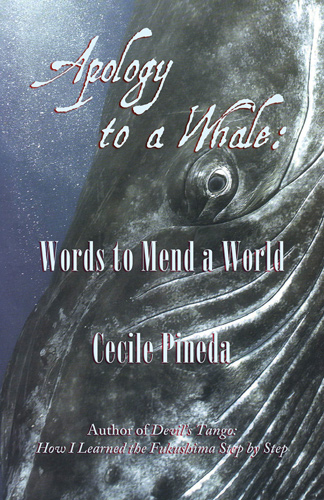
Apology to a Whale: Words to Mend a World (Wings Press, 2015) is categorized as philosophy and attracted some illustrious blurbs when published. I'll let one from a prominent environmentalist speak for itself:

Cecile Pineda has the nerve to ask the one simple question that eludes our public posturing....It is the one question that could save us: 

What has happened to our mind that we are killing our world? 

What is it, at the root of our culture that sets us against the rest of creation? 

The genius of this book is that the question [itself] supersedes the answers and takes us on explorations where we make our own discoveries. These widening apprehensions not only pierce us with heartache for what we have lost, but invite us to examine the imprisoning structures of the very language we use. 

Cecile Pineda has the rare and enviable capacity to address the big questions without falling into abstractions or sermonizing. It is the artist in her that I trust, and that utters so potent a call to personal and collective liberation.

Joanna Macy, author of Coming Back to Life

If you've asked yourself these questions, this book is for you.


Cecile's book with the biggest impact for me, personally, was undoubtedly this one. 


Devil's Tango: How I Learned the Fukushima Step by Step (Wings Press, 2013) argued a thesis that acted as a tsunami demolishing my lifelong dread of nuclear war. It's not that I don't still dread it (and notice it creeping closer with each passing day), it's that I followed Cecile's carefully reasoned argument that nuclear holocaust is already here. Constant pollution from radiation leaks, accidents, and deliberate use of ordnance composed with depleted uranium already have global cancer rates and birth defects skyrocketing. Continuing to build nuclear power plants and nuclear weapon systems without any meaningful plans for containing the waste, much less the radiation produced by accidents, is collective suicide. Fukushima was a disaster waiting to happen and another earthquake could replicate it on any of several coasts around the planet. 

I am deeply grateful to Cecile for both educating me and stimulating my ability to hold unwelcome truths in mind without succumbing to despair. 

A selfie with Cecile, Berkeley, spring 2022


Cecile Pineda, ¡Presente!


Take Action

World Beyond War Sign the petition: Don't get Yanked into war with China!

Roots Action Sign the petition: No to war, hot or cold, with Russia.

Send a Letter to Biden: Sanctions Fuel the Fire In response to the catastrophic fire at Matanzas energy facility in Cuba, an open letter signed by a growing list of prominent figures in the US and internationally, including Cornel West, Roxanne Dunbar-Ortiz, Noam Chomsky, and Jeremy Corbyn, calls for lifting sanctions on Cuba.

International Campaign to Abolish Nuclear Weapons (ICAN) Ask your elected officials to take the pledge to promote the Treaty on the Prohibition of Nuclear Weapons.

Sum of Us Tell the Japanese government: don't dump Fukushima nuclear waste water into the ocean!

Our Children's Trust Demand Biden’s Department of Justice and Attorney General Merrick Garland end their opposition to Juliana! The 21 youth plaintiffs, from across the United States and including 11 Black, Brown, and Indigenous youth, in their landmark youth-led constitutional climate lawsuit Juliana v. United States need your support today! For seven years since the case was filed, young people have suffered from increasingly severe climate harms and we need our nation’s courts to do their duty and protect the rights of our children to a safe climate. 

DontExtraditeAssange.com Sign the new petition. The UK must comply with Article 4 of the US-UK extradition treaty: "Extradition shall not be granted if the offense for which extradition is requested is a political offense."

Lakota People's Law Project Please send President Biden an email today, and ask him to cement his legacy as an advocate for Native communities by taking action to protect our children and sovereignty, up to and including an Executive Order.

1CM69 STOP! SpaceX Starlink from Spoiling Outer Space for Humanity, sign the petitionSpaceX was given the green light by the FCC in the USA to launch a network of satellites in to Low Earth Orbit, 60 at time of writing, rising to 12,000 over time. These satellites will forever ruin the view of the heavens for the entire planet.

#DeleteFacebook trended and thousands left  both Meta platforms (FB and Instagram) after learning that the company had turned over private messages between a 17 year old and her mother leading the felony charges for murder as the two procured and the daughter used abortion pills. You can delete your account on these apps, too.


Roses Amidst The Thorns

🌹The U.S. Army has so far recruited only about half the soldiers it hoped for fiscal 2022.

🌹70% of younger voters have lost faith in both the Republican and the Democratic Parties to represent the needs of the people.

🌹Green Party U.S. Senate candidate Matthew Hoh is on the ballot in North Carolina following a successful lawsuit against Democratic Party shenanigans to keep him off.

🌹Christopher Cooper, the Black man who a white woman falsely claimed to police was attacking her in NYC Central Park, will be hosting a new tv show, "Extraordinary Birder."

🌹More workplaces have filed to form a union this year than in all of 2021 including workers at Starbucks, Amazon, and Trader Joe's.

🌹Caitlin Johnstone, Australian blogger extraordinaire, examines "the end of illusions" with humor on a daily basis.


Saturday, February 11, 2017

When The Fire Is Happening, I Have A Responsbility To Say So

Image: Wikipedia Commons "A map of all Superfund sites. The red dots are active sites, and the green dots are clean sites."

Today I continue with the third in a series of posts expanding on the rich discussion between Sherri Mitchell, Rivera Sun and Professor Tom Hastings "War On Earth: Militarism and Environment" linked below (go here to read posts #1 and #2 in my series.)


I was inspired by the testimony of Zumwalt 12 defendant Cynthia Howard, on trial for blocking a public road in front of General Dynamics' weapons of mass destruction plant in Bath, Maine:


I know that my first amendment rights do not extend to yelling "Fire!" in a building, but when the fire is happening, I have a responsibility to say so.

So, where's the fire?

Image from Politico's 2015 article "Where in the World is the U.S. Military?" by David Vine, author of Base Nation

Sherri Mitchell: "Worldwide..there's an incredible amount of land that's under the control of the military. How do we address those issues and try to clean up some of the lands?"

Then there's the problem at home on what were once and in some cases still are Native territories. According to Alexander Nasaryan's 2014 article "The US Department of Defense is one of the world's biggest polluters" in Newsweek

about 900 of the 1200 or so Superfund sites in America are abandoned military facilities or sites that otherwise support military needs.

The US Department of Defence is one of the world’s worst polluters. Its footprint dwarfs that of any corporation: 4,127 installations spread across 19 million acres of American soil. Maureen Sullivan, who heads the Pentagon’s environmental programmes, says her office contends with 39,000 contaminated sites.

A list of military Superfund sites runs to 142 and is always expanding. Superfund sites are toxic waste locations prioritized for federally funded clean up operations.

The government cannot be relied upon to solve the problem they continue creating. According to Professor Hastings: "It is 100% up to civil society to address." He was part of a coalition that successfully sought an injunction against a military base in Wisconsin that "had a very faulty environmental impact statement... Then it took the Navy about ten minutes to go down to the circuit court in Chicago...to lift the injunction." Hastings reported the Navy's rationale for lifting the injunction consisted of approximately two sentences that amounted to this: national security.

This is an amazingly short sighted view of real security for the future of people residing on our planet. I think in this instance "national security" can be read to mean: securing continued business opportunities for the super wealthy who profit from the manufacture of weapons systems we all pay for.

For example, real security would necessitate cleaning up superfund sites at home and contaminated lands abroad that have been pulverized by missiles made from depleted uranium. Cecile Pineda argues convincingly in Devil's Tango: How I Learned the Fukushima Step by Step that we need not fear nuclear war in our future because it is already upon us

Since the US began slowly killing its own soldiers present at the testing of a nuclear bomb in 1945, radioactive military waste that will outlive you and the next 777 generations of your family has continued to pour into our soil and oceans.


Veterans and their families continue to struggle with health issues that stem from their exposure to toxins decades ago. Mothers in countries the U.S. has bombed with DU continue to bear children with severe birth defects

Still, Hastings remains optimistic about the power of the people to fight polluters in uniform: "Whichever administration is in power, we're still able to do things at the civil society level ... As long as we  continue to build bigger coalitions on the ground, we can win." His view is shared by organizers like Sun and Mitchell, and by groups like Popular Resistance who build coalitions around national health, opposition to militarism, and urgent concern for the environment.

Time to yell "Fire!" yet?

Monday, January 4, 2016

Interview: Cecile Pineda, Author Of Apology to a Whale: Words to Mend a World

My Photo
A written interview with Cecile Pineda, whose latest book I reviewed yesterday on this blog.

Q: The common thread between your two works of non-fiction is environmental peril. Devil's Tango: How I Learned the Fukushima Step By Step presented a picture of our world already deep in nuclear war and nuclear denial. Would you agree that your newest book, Apology to a Whale: Words to Mend a World, is more about causes and less about effects?

A: Indeed the concepts addressed by Apology to a Whale: Words to Mend a World in comparison to the emergent concepts of Devil’s Tango: How I Learned the Fukushima Step by Step written in horror’s white heat following the three-meltdown-catastrophe of Fukushima, are far more remote in terms of tracing, as they do, our cultural discontents back some five thousand years. For me personally, it places our planetary dilemmas: global warming, perpetual warfare, in a much wider perspective than simply the contemporary horrors through which we must live in our times. It allows me perspective. At the same time, I suspect that our emergent problems are even more intractable than we may have assumed because they originate not in such relatively recent matters as the arbitrary partition of Iraq by the British following WW I (for example) but in pre-history.

Even before touring ten states talking about my book, Devils Tango: How I Learned the Fukushima Step by Step and the threats posed by the nuclear industry to all life on Earth, I had formulated a question that much later was to give rise to the publication of Apology to a Whale: Words to Mend a World. That question as I posed it in Devil’s Tango went: “I am trying to understand being born to the urge to destroy, to rip mountains apart, to pour thousand-year poison into the seas, to belch soot into the sky, to kill everything that lives. Where does it start, this impulse? In what mind? What axel drives this wheel?”

It became the most-asked question by the thousands of people I addressed during those tours. From then on, the question  refused to leave me alone. To this day , it absolutely astounds me that, indeed a wheel—the wheel conjured in how I originally cast my question—along with weaponry—lies at the heart of a conquering civilization—that of the Kurgan Invaders of  Europe in 3500 B.C.—a invasion which brought us the language we speak today. English (one of Europe’s proto-Indo-European-descended languages) is universally spoken; it has become the global coin of exchange by which diplomacy and commerce are conducted the world over. The ultimate cultural articulation of white European civilization’s proto-Indo-European-derived languages is apparent in the technologically dominant civilization that pervades today’s world. The Kurgans were the first to introduce wheeled vehicles to Europe.

The implication for my assertion is simply this: the Kurgan invasion of Europe, paralleling as it does the much later European invasion of the American continents, has now reached global proportions. Its sweep has extended to the outermost reaches of our planet. But to begin with, in roughly 3,500 B.C., it was a marauding sweep spilling out of the steppe of the area that is now Russia, by a tribe of horsemen who first introduced warfare, weaponry, conquest of territory, patriarchy, hierarchy, a male sky god replacing the goddess of Earth previously venerated by almost all the world’s indigenous people, and most critically, the original language from which all but four European languages are descended:
proto-Indo-European.

Why is that understanding critical to understanding where to place ourselves on the continuum of the world civilizational map? Because language is the most lethal weapon of all to be introduced by the original proto-Indo-European invaders. Unlike swords, spears, halberds, and shields, language replicates itself analogously to living cells by passage from parent to child and down the long march of generations to the present day, embedding beneath its words and grammar deep cultural concepts acting like DNA, passing from one generation to the next. That DNA is something we refer to as values.

Q: You posit that Proto-Indo-European languages with their structures of control and power may be part of the problem with living sustainably on Earth. Can you give some examples of the connection between language and how humans live on their planet?

I propose a wider study of language. My January blog post takes a look at 11 small Japanese words,* none with an English equivalent, yet each evoking ways of Being in the World in more contemplative and peaceful ways.

Q: Patriarchy and militarism are addressed in separate sections of Whale but you seem to feel that they are closely related as root causes of the despoiling of Earth. Also as barriers to indigenous peoples being able to bring their wisdom to stewardship of our shared environments. How do you see these things connecting?

It seems to me the links between patriarchy and militarism are fairly obvious on the most superficial level: in white European tradition warfare has been the glorified purview of male warriors as the ultimate articulation of machismo. And winning warfare depends on rigid hierarchical discipline. A culture enshrining militaristic values discourages and precludes contemplation let alone espousal of the gentler values exemplified by indigenous recognition that all beings  are sons and daughters of our planet and not occupiers of it. The implication of being part of one’s landscape rather than owning, and presuming to control it, is that appropriate husbandry of the Earth is a way of living, not the more distancing view that Nature exists for Man’s control. But the links between  militarism, and gender equality are infinitely more elusive.

Here is Phillip Slater in A Dream Deferred: 

Some years ago I suggested… that this gender difference derives from the fact that while young girls can identify with their mothers (still the principal caretaker in most families) as part of their maturation, boys are expected to separate their lives from their mothers while retaining an interest in the opposite sex, leading to a lifelong proneness to compartmentalization.  But how much of this masculine need to separate and differentiate is derived from the residues of authoritarian culture—from the warrior’s need to make himself into a block of wood? If there was no longer any cultural demand for men to deaden themselves to “softer” feelings—if they were no longer pushed by the demands of macho tradition to deny their own vulnerability—how much of this rigid abnegation of the mother would be necessary?”

Q: The most interesting thesis of Whale was contrasting the attitudes of terrestrial beings with those of the sea. In short, those of us who walk on land need territory while those of us who don't share a common, borderless realm. Could you expand some more on how you see this playing out in the 21st century?

The imperatives with respect to territory of terrestrial beings in contrast to those inhabiting the seas is, among the many concepts offered by Apology to a Whale, probably the most problematic, one because it assumes that marine beings practice no behaviors observing concepts of territory. Marine animals, particularly cetaceans, but many others as well, observe specific locations for feeding, breeding, and migration. And two, perhaps the assumption that different clans and species practice what I have identified in the book as “arrangements” or “agreements” is also problematic, although evidence seems to indicate that such arrangements and agreements resemble the way indigenous peoples also chose to relate to one another. At best, we are swimming on shaky ground here, but applied to territory on Earth, we are seeing borderlessness attempting to play itself out with the hemorrhage of migrants from Syria where covert, collaborative US-ISIS led bombings and dronings have made living intolerable; from Africa, where despair brought about by economic hardship drives migrants to drown by the thousands crossing Mediterranean Seas, from Mexico and Central America, where the so-called “war-on drugs” and the economic devastation imposed by NAFTA have made living, actual survival, impossible.

Q: I was particularly intrigued by your mention of evolutionary biology and the possibility that Cetacean species both emerged from and returned to the oceans. Where did these ideas come from? What are the implications, if any, for the future of life on this planet?

The study of paleontology confirms that cetaceans originated as land dwelling animals.

“Fifty million years ago—long before the first primates stood erect, an awkward, ungainly animal not much larger than a cat roamed Kashmir. Indohyus had a silhouette closely resembling that of a terrified opossum. It had a bone growth pattern characteristic of a cetacean. North Pakistan was home to Indohyus’ cousin, Pakicetidae…. Its highly unusual skull identifies it as a cetacean.  After a million years or so, [fossils of] the Ambulocetus, [whose] lower jaw housed a fat pad, like that of modern whales…are always found in shoreline marine deposits.… Primates would inherit territory. Whales made another choice.”

This is a direct abridged quotation from Apology to a Whale.

You ask about the implications for the future life of this planet.  On this home of ours, anything is possible. There are even extremophiles that manage to inhabit and thrive in highly irradiated environments. Life wins every time, but the forms it takes result from the pressures exerted by survival in challenging environments.
The deepest implication I take for any future life on this planet is that human beings have absolutely no real, visceral sense of deep time. Like Darwin, product of his patriarchal Victorian times, we hierarchically assume that Man is creation’s greatest glory. As such we congratulate ourselves we don’t have to think beyond units any longer than a human life span. That short sightedness, that arrogance, has gotten us into deep trouble.
In conclusion I offer the example of the Ju/wasi, the Earth’s earliest people, identified by anthropologists until very recently as the San. The Ju/wasi still  live according to astronomical time. They alone can identify a constellation in the Southern Skies, the Greenleaf Horn. And they can do it because their racial memory goes back 60,000 years. But in terms of terrestrial time, even that vast span of Ju/wasi time occupies only 1/75,000th of the age of Earth.
* A visit to a few heavy lifting Japanese expressions might lend New Year resolutions some weightier meaning. The 11 words that follow may suggest new relationships to nature; to appreciation for others and for all things good; to recognition of beauty and transcendence from the smallest bowl to the great wheel of sky we call the universe; and to entering the realm of acceptance in life. They evoke vast complexes of meaning. English has no words for them.

Here they are:

NATURE

•Forest-grazing is the clumsy English usage for what the Japanese refer to simply and elegantly as shinrinyoku. It describes that need for the wilderness in which to find peace, and the stillness that comes of experiencing deep silence.

•The Japanese use komorebi to refer to sunlight filtering through the leaves.

•Kogarashi is the name for the chill wind that announces winter coming. Unlike the classic name Boreas, the Japanese name the winds according to their gifts.

BEAUTY & TRANSCENDENCE

Kintsukuroi  refers to the art of repairing broken ceramics using silver or gold to join the shards, but encompasses awareness that the object becomes even more exquisite for having been broken.

*The Japanese lend mutability its correct poignancy. Monoaware literally means the pathos of things, not just their impermanence, but the soft sadness that lingers at their passing.

•Beyond words has its Japanese expression. Yuugen evokes awe and mystery beyond words of the universe itself.

ACCEPTANCE

Shoganai in Japanese literally means “it can’t be helped,” but far from evoking discouragement or despair, it acknowledges the need to accept things beyond human control and suggests the freedom from guilt, and regret that allows moving on.

Wabi-sabi  pinpoints a whole way of living that uncovers beauty in life’s imperfections, and leads to a path of acceptance for the natural cycle of life from its beginning to final decay.

APPRECIATION

•Before a meal, the Japanese say itadakmasu!  Although its literal meaning is I will have this! it acknowledges the person who prepared the food, the person who served the food; and it includes appreciation for nature and for life itself. (It also includes everything else related to eating, maybe even thumb sucking.)

•The Japanese acknowledge heavy lifters themselves by saying “you are tired.”  But otsukaresama embraces lots more feeling.  It recognizes the hard work that led to  that tiredness, and it expresses thankfulness for the work itself.

I am indebted to Marie Sugio who must be tired after offering such poignant insights into Living Well (see http://theodysseyonline.com/le-moyne/11-beautiful-untranslatable-japanese-words/221351).

________________________________________
To order Apology to a Whale: Words to Mend a World visit wingspress.com. Also available on Amazon. 
Click here to READ AN EXCERPT.

Sunday, January 3, 2016

Review Of Apology To A Whale: Words To Mend A World By Cecile Pineda

ORDER from http://wingspress.com/book.cfm?book_ID=199

I finished Apology to a Whale: Words to Mend a World on my granddaughter's first birthday. The delight I feel for this child's appearance on the planet is tempered with my anxiety about her future. Will Earth even be livable by the time she reaches maturity? What kind of environmental chaos and biological upheaval will she need to be resilient enough to live through?

Author Cecile Pineda is a poetic writer who turned late in life from writing novels and directing theater to researching and writing a unique form of non-fiction. Her previous book about the disaster at Japan's Fukushima nuclear reactors in 2011 had a profound effect on my thinking about the mess we're in. It was interesting to me that my husband -- who has studied about and educated others about the perils of the nuclear industry for years -- also found that Tango informed and stimulated his thinking. We've both read that book more than once.


The common thread between Pineda's two works of non-fiction is environmental peril. Devil's Tango: How I Learned the Fukushima Step By Step presented a picture of our world already deep in nuclear war and nuclear denial. Her newest book, Apology to a Whale: Words to Mend a World,  seems to me more about causes and less about effects. She was inspired to write the book after watching Arctic sea ice melt and imagining for an instant that a calving piece of ice was actually a whale.
Photo credit: NASA
The intriguing thesis of Whale contrasts the attitudes of terrestrial beings with those of the sea, observing that those of us who walk on land need territory while those of us who don't share a common, borderless realm. 

Pineda speculates that even pre-patriarchal cultures who live upon Earth with respect, love, and communal values emphasizing sharing do need territories. She wonders if life on land could be lived without the boundaries and borders that carve out individuals and discrete nation-states with their aggressive, competitive tendencies. It's an interesting question to ponder.

Pineda toys with evolutionary biology and bits of evidence suggesting that species with markers of Cetacean structures (shared by whales) both emerged from and returned to the oceans. It made me wonder if life, which is said to have emerged from the primordial soup of the oceans, could still make a U-turn and head back to the seas. Are they now too carbon-loaded and acidic to make this possible? Or am I just thinking like a primate again? The author's discussion of the role of cells in evolution and of the existence of cells from one body being found in another (mother's cells in offspring, and vice versa) is also intriguing. 

Pineda writes at the intersection of science and poetry, a fertile and thought-provoking location.

Patriarchy and militarism are addressed in separate sections of Whale but they feel closely related as root causes of the despoiling of Earth. Also as barriers to indigenous peoples being able to bring their wisdom to stewardship of our shared environments. 

Pineda sees Proto-Indo-European languages with their structures of control and power as part of the problem with living sustainably on Earth. She cites Marija Gimbutas' Kurgan invasion as a possible turning point for human beings in spreading both the language family and the domineering attitudes that have led us to the brink of climate chaos and possible life extinction. 

Pineda, if I understand her correctly, would have us go back even farther than Gimbutas' gynocentric civilizations of the goddess. She doesn't say how, but she suggests that our goal must be to return to the wisdom of Mother Whale. 

She leaves us with a final image of two whales swimming along the surface, spiraling as they mate so that each has a turn to breathe. The depths below are the realm where they've lived peacefully together for eons without disturbing the environment that supports them. We would do well to emulate them.
"Eubalaena glacialis with calf". Licensed under Public Domain via Commons

Tuesday, August 7, 2012

Remembering Hiroshima and Nagasaki, Forgetting Fukushima

-->I had a dream in early summer, one I suspect I'll always remember. I was the passenger in a car with an old high school friend at the wheel, which might explain why he was humping my leg and I was pushing him away in the opening scene. Next the car began to roll forward carelessly, and I perceived that we were at the edge of a grand canyon vista of reddish layers of earth, eroded, beautiful and vast. I called out in alarm and my classmate applied the brake; he wasn't much concerned, he had it under control. Moments later we were rolling again and I repeated the alarm, now scrambling my foot over to the brake pedal, my hand upon the wheel as the car teetered on the edge, dipping forward in its dance with gravity, flooding my view with menacing, beckoning beauty. 

We surpassed the tipping point, and the car began to fall. At the same instant I gave up the struggle and heard my inner voice say, without regret, I had a good life. The car fell gently, and I checked out before impact. A final scene consisted of meeting with bewildered elders in a place nearby; they weren't there to assign blame, but they genuinely wanted to know how I could have let it happen.

In Devil's Tango: How I Learned the Fukushima Step by Step Cecile Pineda has delivered a poetic, profound meditation on the slowly unfolding death of the natural world by man-made radiation. She's not the only one who sees it, but she's in a very small group of people currently alive on the planet who are able to face annihilation without blinking. Oprah will likely not be picking up her book, but I will be finding Pineda's novels (Face, The Love Queen of the Amazon, Frieze) to read as we coast downhill toward oblivion.

When I remember Hiroshima (the first place destroyed with nuclear weapons 67 years ago yesterday) and Nagasaki (the second place destroyed by a different type of nuclear weapon 67 years ago) I can't help but continue to remember Fukushima. Here I think in terms of a table or chart juxtaposing what my fellow citizens think they know about these far off places with names difficult to pronounce, and what I think I know about places I visit only in my mind.
 
-->
Place in Japan What U.S. citizens “know”
What I “know”
Hiroshima

広島市
Bombing it saved untold numbers of U.S. lives by making a ground invasion of Japan unnecessary Japan was already negotiating for surrender, and had long since lost the war; their economy was so crushed that they were building kamikaze planes without landing gear in order to save yen; President Truman said: we have spent so much money building these weapons, we have to use them.
Nagasaki

長崎市
The Japanese still didn't surrender after Hiroshima, so we had to show them we weren't kidding.
--> We were in too much of a rush to allow three days for Japan to react to Hiroshima with unconditional surrender; we were testing a completely different type of nuclear weapon; we were making an example of Japan so the Russians, the Chinese, and anybody else would think twice before challenging our power to destroy. Fukushima

福島市 The nuclear plant failure was caused by a tsunami, it contaminated a rural area right around the plant, and it's all under control now. --> Radiation alarms went off when the earthquake hit, hours before the tsunami; the Mark I Boiling Water Reactors at Fukushima have a design flaw that dooms them all to fail eventually due to containment vessels that grow brittle; General Electric made them and sold them to Japan following the Marshall Plan economic buildup of Japan as a de facto colony/aircraft carrier of the U.S.; TEPCO has successfully argued in court that it has no liability for the radiation released by Fukushima's venting; the radioactive plume continues to unfurl across the skies and in the oceans of the Northern Hemisphere; Reactor #4 is still in critical state and, if its fuel rods go, Earth could become uninhabitable by humans for 4.5 billion years or so; President Obama takes huge campaign contributions from the nuclear power industry, and continues to budget tax-funded expansion of both weapons and nuclear power production; the U.S. quietly stopped monitoring radiation levels on the West coast, and agreed not to ban any food from Japan, post-Fukishima; women and especially mothers and grandmothers in Japan hold daily protests against the use of nuclear power which are almost never reported in the mainstream press in the U.S.
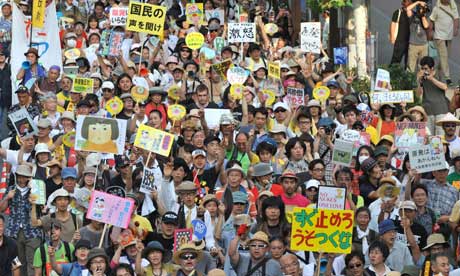
The Guardian July 30, 2012 ran this photo with the caption Protesters hold placards and shout slogans as they march to form a 'human chain' around Japan's parliament in Tokyo, to demonstrate against nuclear power plants. Photograph: Kazuhiro Nogi/AFP/Getty Images
Pineda uses Fukushima as a jumping off point to make a convincing case that production of nuclear fuel for whatever purpose is effectively conducting war on the living inhabitants of the world. She acknowledges that a culture built on attending to the shiny surface of things is designed to overlook: The hundreds of thousands of nameless Russians who died burying Chernobyl. The fact that your government makes weapons out of depleted uranium, weapons that have been used in Iraq and Afghanistan and many other places, creating soil and dust that produces human fetuses so deformed they are not recognizably human. The fact the U.S. is full of G.E.-built Mark I Boiling Water Reactors, many sitting on top of seismic faults, others sitting right on the shoreline of the Pacific or Atlantic region of Earth's one ocean. 

The fact that, if you're my age, you can probably no longer count the people you've known who survived, or did not survive, cancer. Cause and effect break down when cause is an invisible, tasteless, odorless substance that takes longer to break down than does the human body.

Pineda suggests reading Greg Palast's Vulture's Picnic for a more detailed examination of the central nuclear industry truth, "it turned out that fixing the regulators was cheaper than fixing the problem." In case you want to know why your government uses your own money to kill you for the profits of a few. Pineda herself is more interested in examining the details of who stops cooperating in the death-for-profit game. She quotes a farmer who helped bring a lawsuit to block yet another Japanese nuclear plant from starting up, Hatsumi Ishimaru: "Women are at the head of the anti-nuclear campaign because we value life more than economic gain."

Official pronouncements coached by top dollar public relations firms can steer public perception, but they cannot change facts on the ground. Pineda writes:
...it's conceivable that in the larger scheme, Mother Earth may be the "decider" notwithstanding her failure to be recognized by the government -- or any other government for that matter -- with the exception of the government of Bolivia.
If she has any hope left, it's riding on the rise of the global 99%. She quotes Takanobu Kobayashi, an activist who leads Japanese citizens in the relentless pursuit of life over death: "We do not trust the government anymore."