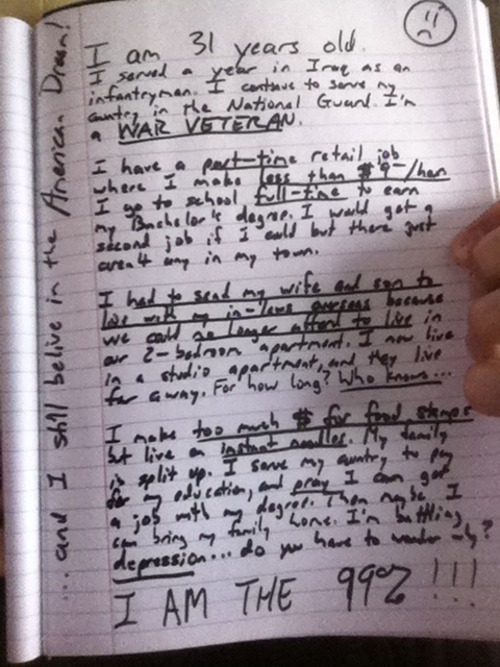
Reposting below from the Jobs Not War campaign just as news came that the U.S. Senate authorized over $600 billion in military spending for fiscal year 2013. Austerity is a sham. Let's make a big noise about it.
Call your Members of Congress on Dec. 5th and tell them…We voted for JOBS, not CUTS – WORK not WAR 1-866-426-2631 or 1-800-998-0180 On December 5th, thousands of Americans will pick up the phone to call their Members of Congress and tell them not to sell out working class families by cutting Medicare, Medicaid, and vital services, destroying millions of jobs and hurting children, seniors and people with disabilities. Tell them that the best way to reduce the deficit is to create jobs, end tax breaks for the rich, demand that they publicly agree to protect Medicaid, Medicare and vital services, and move funds from the runaway Pentagon budget to meet peoples’ needs. Call 866-426-2631 to get more background information on the threat to Medicare and Medicaid and 800-998-0180 about Social Security, and either to be connected to the offices of your Members of Congress. Call 1-866-426-2631 or 1-800-998-0180 on Dec. 5th to say NO to cuts for Medicare, Medicaid and vital services. Then sign the JOBS-NOT-WARS PETITION at www.jobs-not-wars.org
We were at Obama campaign headquarters in Portland, Maine yesterday to stand up for
imprisoned whistleblower Bradley Manning. There was only one person working in the amazingly obscure location chosen for the
campaign offices in Maine's largest city, miles from downtown and upstairs
from a mattress store that has been going out of business for several years. The lonely
field coordinator working in an suite of offices devoid of volunteers
would not take our petition because "I'm not at that pay
grade." I left it there anyway, on the bathroom sink, and we shared a lot of stickers.
The petition is particularly poignant because its online version includes the testimony of scores of disappointed former Obama supporters, people who actually worked to get him elected in 2008. I printed it out and I suspect that Obama field organizers really ought to read it. A typical comment by a signer goes like this:
Judy Stiller signed
I gave money when I really could not afford to do so. I
canvassed and used many social media websites to promote Mr. Obama for
President. I regret every bit of it. President Obama has caved to the
right at every turn. Do the right thing and let this young hero go free!
The field organizer tried to tell Portland CODEPINK Local Coordinator Pat Taub and I that "Many people don't realize that Congress hasn't let..." but I am afraid that I interrupted the flow of scripted response to criticism of the POTUS to share that imprisonment of Bradley Manning is all Obama's. Well, actually I said something like, "I'm not sure you understand -- under our form of government, the punishment of whistleblower Bradley Manning is the responsibility of the Executive Branch. Attorney General Holder and the Justice Department are also part of the Executive Branch, and their failure to prosecute war crimes that Manning revealed, meanwhile allowing him to be tortured at Quantico, has nothing to do with Congress."
It was exciting to know that people in more than 30 cities all over the U.S. were visiting Obama campaign HQ to share similar messages. Pat made sure to make that point.
It doesn't matter what pay grade human beings define themselves by. They still have hearts and minds, and we can still reach out to offer them some truth. I really should have heard her out, and not interrupted. My bad.
I came home to find exciting news of several bold actions by my Pink sisters and brothers at the Democratic Party national convention in Charlotte. Rae Abileah had interrupted Steny Hoyer's speech by unfurling a banner and calling out, "Bring our war dollars home!" a meme that originated in Maine and has spread widely during the time Obama has presided over a federal budget that climbed from 51% to 57% military spending.
Then, in downtown Charlotte, pinksters unfurled a giant pink slip with a version of the slogan Obama campaigned on: YES, WE CAN END WAR. Twenty-three year old Codepink staffer Alli McCracken was surrounded by 32 police officers and arrested for attaching the banner unlawfully to a parking garage. The magnitude of this crime can really only be appreciated by viewing said pink slip, the handiwork of prop genius Tighe Barry.
To paraphrase one of my favorite Occupy Wall St. slogans, if banking regulations were enforced as well as ordinances against unlawfully displaying banners in this country, the economy would not be such a disaster for the 99%.
I spent a pleasant afternoon yesterday in an old barn helping to make t-shirts for the Bring Our War $$ Home campaign. Steve Burke swiftly screen printed about 135 organic cotton shirts in all sizes which will be shared with the public at Maine's big annual Common Ground Fair in late September. We'll ask for a donation of $5 for the shirts, which would just about pay for our material costs. All the labor has been freely donated -- including artist Nora Tryon's design -- submitted as part of the campaign's ongoing collaboration with the Union of Maine Visual Artists via Draw-A-Thons and Print-A-Thons.
Steve and Bruce Gagnon helping to make BOW$H t-shirts.
We've produced several t-shirt designs in the past, but "Babe in Arms" has been super popular as a poster, and as a t-shirt image seems to be the one that pops best in photos.
I'm shipping off a few at the request of women and men who'll be at the Republican National Convention in Tampa next week, and hope to see them on tv news coverage if there is any of the "free speech zone" located far away from the convention venue. (Such is what passes for rights guaranteed to citizens under the 1st amendment to our Constitution.)
It's a good image to pair with CODEPINK's campaign to "Bring our vaginas to the RNC" which responds to GOP fear mongering about abridging women's reproductive rights. Young women will never stand for this, and a new generation embodied by the Russian punk band Pussy Riot will be formidable opponents for the likes of men who want to control vaginas, but try to silence female lawmakers who speak the word.
Sign reads: VAGINA Can't say it? Don't legislate it!!
Bring Our War $$ Home is a campaign based on the notion that one can hardly get fellow citizens to pay attention to the fact that the U.S. is still embroiled in its longest war ever, that soldier deaths in Afghanistan were higher in July, with about one per day, that recruiting aimed at children roars on, and that many fear war on Iran is next. Since all those things are far less interesting than, say, the Olympics (viewers who watched daily reported gaining an average of 4.2 pounds while doing so), our campaign uses a pocketbook-aligned message to point out that cuts to any social programs could be avoided by re-directing even a fraction of the Pentagon's budget.
As hard working people continue to falter economically -- losing their homes to foreclosure, their jobs to outsourcing, and their prospects for solvency to a lifetime of crippling student debt -- will they look up from the television and notice where all the money is flowing?
The President asked for a budget next year with a whopping 57% for the military. How is it that anti-war Democrats can continue to support his losing policies? Why do voters continue to send people to Congress who enable the destruction of our health and prosperity as a nation? (Interview here with Bruce Gagnon with his views on the Pentagon's death grip on our government and the globe.)
Seven out of 10 people in the U.S. surveyed said they no longer support the war in Afghanistan. But who cares what they think?
And yes, in case you were wondering, CODEPINK women and allies will also be in Charlotte to protest at the Democratic National Convention over Labor Day week. So Wall Street South will see our t-shirts, too.
I work with low income youth in the most low income county in Maine. Our guidance director asked a young man how she could help him be more successful in school a couple of years back. He requested a space heater, because he was living in an unheated garage while attending high school and trying to write a novel. That year she had a college professor ask what percentage of students at our school she considered to be "at-risk" and she replied "All of them."
Even those we would consider middle class are one layoff or illness away from financial collapse. There are a few small business owners that constitute the affluent, and almost no professional class at all. Such people move away from our area, and nearly all the manufacturing jobs left for offshore tax havens years ago.
So it was with bitter irony that, on the day the U.S. House of "Representatives" considered spending $642 BILLION on "defense" next year, and a "GOP budget package [that] would cut $36 billion from the food stamp program by reducing benefits and tightening
eligibility, $23.5 billion from Medicaid and children's health care, $4.2 billion from hospitals that serve the poor and
uninsured, and $2.8 billion from a program that helps homeowners facing foreclosures," Maine's governor rushed to sign into law a budget with these provisions:
o Eliminates MaineCare coverage for another 14,500 low-income working
parents (those with income between 100-133% FPL). As part of a
compromise earlier this session, the legislature already voted to
eliminate coverage for 14,000 working parents between 133-200% FPL.
This would double the amount of parents who will have coverage
stripped from them and targets parents who are struggling with even
fewer resources.
Cuts to many programs supported by the Fund for a Healthy
Maine, including:
o Cuts $2M of funding for Head Start,
which means that 216 very young children will no longer have
access to Head Start and the vital supports it provides to these
children and their families. Head Start is an investment in these
children's future, as it provides early care and education, as well as
health, nutrition, mental health, social and family supports;
o Cuts nearly $2M of funding for the Child
Care Subsidy Program. This will lead to a deep cut in the
availability of child care vouchers for families with incomes below
250% FPL and will negatively impact 1,400 children. The child
care subsidy program helps parents with low income to afford the child
care they need in order to work;
o Eliminates funding ($2.6 M) for the Maine
Families Home Visiting Program, which will eliminate vital services
for Maine's most vulnerable infants and children.
Approximately 750 families will lose services focused on
family substance abuse, domestic violence, prevention of abusive head
trauma, and the health and safety of children;
o Eliminates funding ($401,430)
for Family Planning; and
o Eliminates $300,000 for dental services
for people with low incomes and no other source of dental help.
o The complete elimination of MaineCare coverage for 7,000 young
adults (19 and 20 year olds) who are under 150% of the poverty level.
This last item means that if my school's former student develops pneumonia from living in an unheated garage, his health care will be obtained at the emergency room.
Because this is an emergency, make no mistake about that.
If you're in Maine, join us at the next Bring Our War $$ Home organizing meeting Saturday, June 9 at noon in Augusta. Help confused citizens connect the dots between out of control military spending, and the shredding of programs that support our most vulnerable young people.
Welcome,
everyone, and thank you for being here. Special thanks to the
organizers for bringing us together to reflect on our proper roles in
this troubled world. I appreciate being invited to share my thoughts
about the challenges of peacemaking in our day.
I
was born the year that Pres. Eisenhower gave his famous warning about
the impending power of the military-industrial complex. For the last
20 years I've been a public school teacher, but before that I worked
as a journalist, and for a few years in marketing and advertising.
These experiences have informed the way that I understand the
peacemaking job before us, because I approach it from a
communications perspective. I'll return to this theme, but for the
moment I would like to briefly discuss the conditions we find
ourselves in midway through the year 2012.
The
critical mass of federal spending is and has been dedicated to
military purposes, as was predicted by Eisenhower. No matter how you
slice up the federal pie, and allocate spending to various
categories, it is an enormous slice. It is symptomatic of the fact
that all three branches of government in Washington DC have been
effectively “captured” by moneyed interests. Congress fails to
represent the will of the people; as just one example, 69% of those
polled by the NYT said they no longer thought the U.S. was doing the
right thing in Afghanistan.
The Executive branch showed very little
change in its foreign policy following the 2003 electiion; if
anything, it has become even more warlike, especially in the use of
drones and extrajudicial killing. The Supreme Court has also
indicated that it stands with the corporations, by ruling in Citizens
United that they are people and thus entitled to first amendment
protections. Meanwhile, a citizen detained for anything at all –
including a dog off the leash, or an unpaid parking ticket – can be
strip searched according to the highest court in the land.
State
governments are in the process of being captured systematically in a
similar fashion. In our own state big money brought in a third party
candidate to split the vote and elect our Tea Party governor. This
has brought us laws authorizing the capture of public school funds
into taxpayer supported charter schools, and a public-private
partnership where taxpayers pony up $300,000 for a feasability study
of an east-west corridor to truck LP gas from one site in Canada to
another to use for fracking, a private toll road whose profits will
go to the Cianbro Corp. (Great reporting here by Lance Tapley in the Portland Phoenix.)
How
did this happen? Well, for starters, we're the only democracy in the
world whose citizen rely solely on commercial media outlets for news.
In other words, we have no public information services such as exist
in other countries. We do have a vibrant independent media and some
vigorous citizen journalists at work, but they are battling uphill
for attention in the glut of sensationalized entertainment that
passes for news in our day. Just this week I ran across this article in Yes! Magazine, one of the positive forces in the new media
landscape. It reports that the IRS is holding up approval of tax
exempt status for non profit media outlets – for months, sometimes
for years. Meanwhile, the US military has a recruiting budget of $12
billion a year.
So
– depressing no? But there may be some game changers on the
horizon, and we may be looking at opportunities that did not exist
before.
One
of the big changes is killing by remote control. This is
qualitatively different from the aerial bombing that has
characterized U.S. foreign policy in my lifetime, because there is no
pilot in the sky, just a guy with a joystick and a video monitor far,
far away. I believe this change will have a profound effect on the
warrior ethos, and on how our military is perceived by the citizens
who pay for it. It certainly has already had a profound change on how
the US is perceived by others. It is also astronomically expensive,
and has enormous implications for surveillance, including domestic
spying.
Tireless peace worker, the late Tom Sturtevant, at the protest he organized calling attention to the environmental degradation caused by the recruiting tool of the Blue Angels Air Show, at Brunswick Naval Air Station last summer.
Another
inescapable game changer is the environmental chaos that we've been
warned about for decades. The chickens of greenhouse gas emissions,
of offshore oil drilling, of fracking and last but certainly not
least of nuclear weapons and energy sourcing are coming home to roost
quite rapidly now. The Fukushima disaster in Japan continues to
unfold and will likely affect the whole world in due time.
How
much does the public know about any of these things? Precious little,
unless they do quite a lot of their own information gathering, and
are paying attention.
Depressingly,
the majority of those polled about US military use of drones think
its a good idea. If you've been watching the propaganda stream around
the anniversary of Osama bin Laden's assassination, it's easy to
understand how ill-informed your fellow citizens could be on this
topic. Manufactured consent is not a new problem – George Orwell
wrote about it brilliantly nearly a century ago, as has many others.
That
is why I see communication as job #1.
And
with that in mind I'd like to discuss and offer some examples of what
I see as the basics of effective communication.
Both
CODEPINK (the name) and the Bring Our War $$ Home campaign are essentially
communication strategies. After 9/11 as the so-called “War on
Terror” kicked into high gear we got Homeland Security and a bunch
of color coded alert levels: Red, Orange, Yellow and so on. Women
peacemakers asked themselves as they circled the White House: What
could we call ourselves that would refer to and at the same time
defuse the fear mongering of the alerts? Thus Code Pink was born.
Bring
Our War $$ Home speaks directly to the most fundamental principle of
communication : Know They Audience. In education we call this “the
teachable moment” as in, what are these listeners ready to hear?
What have their background knowledge and experiences prepared them to
understand?
Bring Our War $$ Home rally in Hall of Flags, State House, Augusta, Maine 2011.
As
the U.S. economy tanked and the banks were bailed out – while
health care bankrupted millions and foreclosures and student debt
soared – budgets for basic human needs were slashed in our
communities. Most all of us in the coalition of a couple dozen peace
groups had vigiled and protested and met for years, often feeling
that we were mostly “preaching to the choir.” We wanted to reach
out to our neighbors and co-workers, not with a message about how war
is morally wrong – which I know it is – but with a direct appeal
to their own circumstances.
People
can be easily fooled about largely invisible wars happening on the
other side of the planet, less so about their household finances. The
debt party that masked our insolvency is just about over now,and
that is one of the reasons that the Occupy movement broke out when it
did. The 99% had finally run out of cheap credit.
Prior
to that our campaign saw the opportunity to connect with the concerns
of people that cannot afford to take their child to the dentist, or
who get laid off and never are able to find a comparable job. Such
people are consistently amazed by the outlandish scale of guns vs.
butter. A minute of the war in Afghanistan would, for instance, pay
for a full four year degree with all the trimmings from USM. $230,000+. One drone could plug the gap in your local school budget and
re-hire the teachers and other staff who were laid off. Or buy health
care for thousands. And so on.
So
how did we get the message out there? We used every medium we could
think of. Some were of the type associated with CODEPINK as a
national organization: connect with events or persons who do get
covered in mainstream, corporate owned media, and be eye catching –
sometimes you can even make it look fun. Getting the US Conference of
Mayors to pass their first antiwar resolution since Vietnam was an
example – all major press outlets were on hand to cover the annual
urban policy conference, and the controversy created by a floor
debate on the resolution – which passed handily – led every
story. This momentum had been started right here in Portland when its
city council became the first to pass a war dollars home resolution.
Such reslutions were debated, and reported on, in many twons where
they did not pass. But our goal was always to create a space for the
conversation.
Alternatively,
create local news. When Bruce or my husband Mark Roman and others
carried the BOW$H banner in a peace walk led by Buddhist monks and
nuns, the newspapers in every town where they stopped to hold an
event gave the campaign some coverage.
"Military, defense issues top list of people's concerns" by Dieter Bradbury | Portland Press Herald | March 11, 2010
I've
been told by some that my cotton candy pink wig “trivializes our
message” but it, too, is a communication strategy. When I first
wore it to speak at a town hall meeting here at USM, I was in good
company with many informed and articulate speakers. But guess whose
picture they put on the front page of the Portland Press Herald?
Collaboration
with the Union of Maine Visual Artists on a series of Draw-a-thons
and Print-a-thons not only produced images of what our war dollars
could better be spent on, but were a platform for the public to
interact with artists who helped them envision such a change. The
posters, t-shirts and other image carriers have spread far beyond
Maine with the bring our war $$ home message, a slogan by the way
which was deliberately crafted from simple short words that even a
youngster can read.
There
are many other mediums that have carried the message: press releases,
slideshows, blogs, songs, books, leaflets, parade entries, radio ads,
local access tv programs, YouTube videos, tweets, and facebook
events.
Could
you feel us getting younger in that list?
I'd
like to end with just a few notes about what works with a young
audience. Young people care deeply about the environment, and about
fairness, but moralizing bores them. They are visually literate, they
love music and digital forms of entertainment, and chunks of discrete
content – so-called “memes” – will spread like wildfire if
they are sufficiently entertaining.
Young people willingly join in
work that is serious yet fun, important yet playful.
Well
I am a school teacher after all and in my marketing mind I'm always
aiming at a young audience. They shall inherit the Earth and it will
be up to them to make the difference.
You never really know how someone's learning has changed them. If you
do find out it's often long after the fact. Communication, and education, are acts of faith.
Coalition includes Waterville's Karen Heck, who takes issue with 'this war
on poor people'
AUGUSTA -- The mayors of 10 major Maine cities, including
Augusta and Waterville, have formed a coalition to push back against
what they see as a continuing shift of the costs to municipalities and
taxpayers.
Staff photo by Joe Phelan -- Augusta Mayor William Stokes, left,
and Westbrook Mayor Colleen Hilton listen as Waterville Mayor Karen
Heck, right, answers a question during a news conference at the State
House on Thursday in Augusta.
A group of mayors from the state's largest cities announced the
formation of a Mayors Coalition on Jobs and Economic Development, they
said their top priority is fighting the general assistance cuts...
Mayor Karen Heck of Waterville had already spoken that week at the State House in favor of redirecting military spending to human needs at home.
And she has invited me to send her the resolution passed at the US
Conference of Mayors last June in Baltimore so that she can sign it
(it's the res that became part of the mayors' advocacy platform to the
federal government for the needs of urban citizens (more info here).
Wouldn't
it be super if more mayors joined Karen in endorsing the resolution as a
solution to budget cuts? Consider asking your mayor, or otherwise
getting the word out!
Wording of the resolution can always be modified by signers. This what big city mayors passed:
CALLING ON CONGRESS TO REDIRECT MILITARY SPENDING TO
DOMESTIC PRIORITIES
WHEREAS, every member of the US Conference of Mayors and the
Americans they represent, support our brave men and women in uniform and
their families;
WHEREAS, the drawdown of troops should be done in a measured way
that does not destabilize the region and that can accelerate the
transfer of responsibility to regional authorities; WHEREAS, the severity of the ongoing economic crisis has created
budget shortfalls at all levels of government and requires us to
re-examine our national spending priorities; and
WHEREAS, the people of the United States are collectively paying
approximately $126 billion dollars per year to wage war in Iraq and
Afghanistan; and
WHEREAS, 6,024 members of the US armed forces have died in these
wars; and at least 120,000 civilians have been killed in Iraq and
Afghanistan since the coalition attacks began.
NOW, THEREFORE, BE IT RESOLVED, that the United States Conference
of Mayors supports efforts to speed up the ending of these wars; and
BE IT FURTHER RESOLVED, that the United States Conference of Mayors
calls on the President and U.S. Congress to end the wars as soon as
strategically possible and bring these war dollars home to meet vital
human needs, promote job creation, rebuild our infrastructure, aid
municipal and state governments, and develop a new economy based upon
renewable, sustainable energy and reduce the federal debt.
Adopted by the U.S. Conference of Mayors in June, 2011.
Schedule a meeting with your mayor to discuss the resolution
passed and ask your mayor to personally use the resolution to advance
the needs of your community in Washington.
Take a copy of the Mayors' War Dollars Home Resolution
(pdf) to your members of Congress. The pdf includes the full text of
the resolution, talking points, and a copy of the press release from the
mayors' conference.
Write letters to the editor congratulating the mayors for
following the advice of their constituents and passing the resolution.
Consider mentioning your personal involvement in the campaign and/or
CODEPINK's leadership.
Mayor Kitty Piercy of Eugene, OR was the lead sponsor for the war
dollars home resolution, Ironically, she felt unable to travel to
Baltimore for the conference where it was voted on due to budget
shortfalls in Eugene.
BALTIMORE, June 20 – Mayors from around the US met in Baltimore
this week to set public policy for the millions of people living in big
cities, depending on municipal services to stay safe. While Congress
considered allocating another $118 billion to conduct wars next year –
and President Obama absurdly maintained that the costly bombing of Libya
is not an act of war, and thus not subject to Congressional oversight –
mayors listened to the people.
Anti-war activists rallied in Austin, Texas earlier this year carrying
the 'Bring Our War Dollars Home' message. Today, the US Conference of
Mayors passed a resolution calling for the same. Following
a lively debate about adding stronger language supporting troops and
their families, and adding President Obama as a recipient, mayors voted
in their June 20 plenary session to call on the federal government to
stop funding wars, and bring the money home.
The U.S. Conference of Mayors' Resolution Number 59 was only a
twinkle in the eye two years ago when a coalition of citizens alarmed at
endless wars and catastrophic budget shortfalls coined the slogan
“Bring Our War Dollars Home” at activist Sally Breen's kitchen table in
Windham, Maine.
That state's campaign took off on Martin Luther King Jr.
Day in 2010, and soon spread nationally with adoption by the women-led
peace group CODEPINK. Locations across Maine soon adopted war dollars
home resolutions, including Deer Isle, Portland, and School
Administrative District #74, followed by Northampton and Amherst,
Massachusetts and, most recently, by Hartford, Connecticut.
Meanwhile, Congress continued to pass war funding supplemental bills,
but without the support of Maine's two representatives in the House.
Rep. Mike Michaud (D-2nd) and Rep. Chellie Pingree (D-1st) defied
Democrat party leadership to repeatedly vote no on the measures. Pingree
began speaking out in Congress and in the press about the need to
listen to her constituents' demands to end the wars as Maine's economy
unraveled, and local budgets for education, health care, housing and job
training were slashed.
In March CODEPINK brought on board national campaign manager C.J.
Minster, who wrote the text of the mayors' resolution at another kitchen
table, that of co-founder Medea Benjamin. The idea to bring a
resolution to the annual conference of mayors had been proposed to
co-founder Jodie Evans by Los Angeles Mayor Antonio Villaraigosa, the
incoming president of the U.S. Conference of Mayors.
The conference first convened in 1932, as big city mayors came
together in Detroit to consider what could be done to pull their
troubled cities out of the depths of the Great Depression. The New Deal
incorporated many of their ideas, and mayors have met annually ever
since.
"The United States Conference of Mayors calls on the U.S. Congress to
bring these war dollars home to meet vital human needs, promote job
creation, rebuild our infrastructure, aid municipal and state
governments, and develop a new economy based upon renewable, sustainable
energy," the resolution reads, citing the $126 billion a year cost of
U.S. wars and the deaths of more than 6,000 troops.
Mayor Joanne Twomey of Biddeford, Maine spoke out about the current
recession last April when her city council was forced to drastically
reduce spending on K-12 education. At a rally at the State House in
Augusta, Maine Public Radio reported: "As mayor of the city of Biddeford
– we are cutting $1.6 million in our education budget, and last week I
had had it – I'm starting to say it from the podium," said Twomey. "It's
my responsibility as mayor of the city of Biddeford to start saying if
our priorities were straight, if we could bring these war dollars home, I
wouldn't have to be doing this, and neither would the Biddeford school
board."
Kitty Piercy, Mayor of Eugene, Oregon, took the lead by introducing
Resolution 59 stating: “Mayors call on our country to begin the journey
of turning war dollars back into peace dollars, of bringing our loved
ones home and of focusing our national resources on building security
and prosperity here at home. Our children and families long for and call
for a real investment in the future of America. It is past due.”
Piercy was joined in supporting the measure by mayors from Worcester,
Hartford, Baltimore, and a score of other cities. States represented on
the endorsement list included Virginia, Florida, Ohio, New York,
Michigan, Minnesota, New Mexico, and Wisconsin. The resolution flew
through the Metro Economies Committee on the opening day of the mayors'
conference, and the news was picked up by media outlets all over the
world. On Sunday, June 19, Mayor Villaraigosa spoke in favor of the
resolution on television current affairs program Meet The Press – and
the rest is history.
As for who will enforce the non-binding resolution, that is up to the
people. Grassroots pressure to end funding for wars eventually produced
an end to U.S. military presence in Vietnam, presaged by the last time
the mayors considered a war dollars home resolution in 1971. Mayors may
very well be closer to the will of the people than are senators or
presidents. The framers of our Constitution seemed to recognize this
when they put the power of the purse in the hands of the branch of
government supposed to be closest to the people, the House of
Representatives.
Immense profits by weapons manufacturers – and the jobs that depend
upon war funding – are compelling reasons for wars with vague goals and
shifting targets to continue indefinitely. Corporations spend millions
lobbying Congress while contriving to pay no income taxes. Many citizens
are questioning who the federal government really represents.
President Obama said while campaigning that he was not against all
wars, just stupid wars. Bankrupting the country to maintain 800+
military bases abroad, and drop bombs costing $1 million apiece – the
equivalent of 25 teachers' annual salaries – could be the definition of
stupid in the 21st Century. Fellow Democrat Rep. John Garamedi of
California warned this week, “If the president doesn’t move…he will face
a revolution in Congress…It’s coming to that.”
If the President has forgotten that Afghanistan is called “the
graveyard of empires,” the people have not. Their mayors now join the
chorus calling on the federal government to end endless wars, and bring
the war dollars home.
Hall of Flags rally to bring war dollars home to Maine, April 2011
The
Maine
Campaign to Bring Our War $$ Home
and Occupy Maine have announced a rally in the Statehouse Capitol Building Hall of Flags on March
20 from 2-4pm to hear testimony from citizens affected by cuts to
vital services and programs. These cuts are presented as necessary by
Governor LePage's administration and Tea Party legislators, but are
in fact the result of years of excessive spending on the U.S.
military and its wars abroad.
The event is intended to remind
citizens in Maine that our state's share of war spending since 2001
comes to $3.4 billion. Testimony from local government officials,
educators, students and Occupy Mainers will be heard.
Mayor Karen Heck
of Waterville released a preview of remarks she plans to deliver on
March 20: “I see one of my jobs as mayor as connecting the dots for
the people of Waterville between what’s happening nationally and
the effects of those decisions on our lives locally and I believe
it’s past time to bring our military dollars home. We need that
money for our local schools, for our infrastructure improvements and
to support people are suffering from budget cuts to education, health
and welfare services.”
“Our
requests for General Assistance are increasing and local food banks
and soup kitchens are serving more people than ever before. We are
facing cuts to Head Start at a time when we are only able to serve
23% of those families who are eligible...we need to make our voices
heard that spending on the war must stop now,” wrote Mayor Heck.
Representatives
from Occupy Maine in Portland, Augusta and Bangor will testify as
well. Curtis Cole, a student at UMaine, Augusta who participated in
the encampment in Capitol Park until its eviction in December, will
speak on March 20 as follows: “The 1% would like us to believe it
is in our best interest to spend billions of dollars annually on a
defense budget. They would like students to believe that it is in
their best interest to maintain funding occupation soldiers’
salaries; they want us to believe that we can ‘suffice’ without
quality healthcare, teachers, firefighters, and decent
infrastructure. Yet, most of all, they would like society at large to
swallow the ultimate lie: that maintenance of the... Military
Industrial Complex, is needed for our safety.”
The Bring Our War
$$ Home campaign began two years ago in Maine with a rally inside the
Hall of Flags in Augusta, and has now spread nationally. Last summer
the U.S. Conference of Mayors annual meeting passed a Bring Our War
$$ Home resolution, the first time they have taken a foreign policy
position since the Vietnam War. Bring Our War $$ Home resolutions
have passed in Maine by the Deer Isle Town Meeting, Solon School
Board and the Portland City Council. Similar resolutions have also
passed city councils in Hartford, Ct, Amherst and Northampton, MA,
Eugene, OR, and Los Angeles, CA.
Last fall the campaign held a
series of 17 local events in 14 Maine communities, supported by a
radio ad campaign featuring Maine's Humble Farmer, Robert Skoglund on
five Maine stations from Portland to Presque Isle.
According
to Bring Our War $$ Home co-coordinator Bruce Gagnon, "Recent
national polls show that 70% of the American people want us out of
Afghanistan and they want the $10 billion we waste on that war every
single month to be brought back to our local communities and states
to help solve our fiscal crisis. We are not going to have an economic
recovery as long as we keeping flushing people's hard-earned tax
dollars down the endless war hole. We are organizing this action in
order to help people apply pressure on all of our elected officials
to publicly say - Bring Our War $$ Home."
The Bring Our War
$$ Home campaign is waged by a coalition of about twenty groups
including CODEPINK Maine, Global Network Against Weapons &
Nuclear Power in Space, Veterans for Peace, PeaceWorks of Greater
Brunswick, Peace Action Maine, the Peace & Justice Center of
Eastern Maine, and the Midcoast Peace and Justice Group.
Contact: Bruce Gagnon (207) 443-9502 Lisa Savage (207) 399-7623
Hundreds chanting outside AIPAC's annual conference after Israel's best buddy Obama spoke March 4. Besides threatening Iran with military action, the U.S. president absurdly maintained: “we will always reject the notion that Zionism is racism."
The American Israel Public Affairs Committee (AIPAC) has more influence over your government and your tax dollars than you do. Each year they hold a conference in Washington DC where they train thousands to lobby Congress for continued military aid to Israel in the form of credits for weapons systems. This is a 1% dream scenario, corporate welfare for defense contractors.
And if you're going to sell weapons, you need to have wars. So a major focus of the AIPAC conference this year is also promoting a preemptive strike on Iran. Because they might be developing the capability to build nuclear weapons of mass destruction. If this claim gives you the sensation of deja vu, it's because AIPAC was a key player in making similar claims about Iraq in the run up to attacking that country in 2003.
Occupy AIPAC is this year's version of an annual effort to bring attention to the immense, pernicious influence of the Israel lobby. CODEPINK organizer Rae Abileah explained:
Each year at AIPAC's policy conference in Washington, D.C., the
president, powerful senators and members of Congress parade across the
stage in order to prove their loyalty to the Israeli government... AIPAC
Director Howard Kohr will likely appear on stage this March at the 2012
AIPAC conference to make the annual roll call, rattling off the names of
congressional representatives, diplomats and dignitaries present in the
room as if he is the auctioneer at an estate sale. And in a way, he is.
Jeffrey Blankfort summed it up at the excellent Occupy AIPAC summit on Saturday when he said that the role of AIPAC is to "shape the opinion of the American public, and keep Congress in line as well." How this is accomplished was the focus of the summit, and I promise to report in more detail on excellent contributions from Phyllis Bennis, Allison Weir, Chris Hedges, and many more. (Go here for my live-tweets from the summit using the hashtag #OccupyAIPAC.)
A good weekend of action which allowed me to meet people who regularly contribute to my education (Philip Weiss of Mondoweiss! Josh Ruebner of the U.S. Campaign to End the Israeli Occupation ); the chance to hug people I was formerly only facebook "friends" with (Elizabeth Barger of The Farm! Nancy Krickorian of the Stolen Beauty Ahava boycott campaign!); and the chance to be in action with my Pink sisters (Ann Wright, Joan Stallard, Ridgely Fuller and Desiree Fairooz to name only a few that were on hand) as well as CP's hard-working staff, and a slew of new acquaintances.
Strong leadership by Palestinian young women was a feature of this year's protest of AIPAC.
Source: Press TV article "Afghanistan protests to continue until expulsion of US troops"
Could the smoldering Quran pages
discovered in the Bagram garbage dump be like the tallow-greased
rifle cartridges of the Sepoy Mutiny? Tainted ammunition changed the
hearts and minds of Hindu and Muslim sepoys who worked as mercenaries
for the East India Company, and caused an uprising that
was a bloodbath for both sides in 1857. The fact that the offending
cartridges were replaced with a non-greased variety didn't much
matter; when soldiers thought they had lost caste or violated their
religious beliefs by putting beef and/or pork fat in their mouths,
they were angry at the disrespect. As a result the company lost its
governing powers, and the British Raj took another step toward its
imperial grave. Later historians saw the rebellion as India's First War of Independence.
Hearts and minds across Afghanistan
were similarly outraged by an insult to Islamic sacred texts. Reports of
workers at the site burning themselves to rescue the Quran from the
flames called to mind Jewish scholars diving into Nazi bonfires to
rescue the Torah. As word spread of the “mistake” and apologies
were issued, violent outbreaks rolled across the country. The latest
occurred yesterday when a literacy teacher at a military base for
both NATO and Afghan troops opened fire, killing
two foreign soldiers and wounding another. The preceding week saw
riots
resulting in U.S. troop deaths, an attack on U.S. citizens inside the Afghan interior ministry, an attack on a UN building, and a populace so aroused that President Karzai dared not
rebuke them -- as he was called upon by his NATO “allies” to do.
Afghan Youth Peace Volunteers have published
a critique of the sidelining of Afghan people from official
negotiations which have the stated aim of winding down combat
operations in their country. An excerpt:
If a war was being waged in the U.S. we would expect Americans to
demand an end to the war and to have a say as to how it should end.
Likewise, the people of Afghanistan want to have a say in the
negotiations to end the Afghan war.
After all, in
2011, a record number of 3021 Afghan civilians lost their lives.
Afghans who risk losing their lives should have a say in the
negotiations, ironically engineered by the
very players who are killing them ( the UN reported that
‘anti-government elements’ – the Taliban and other insurgent
groups – were responsible for 77 per cent of conflict-related
deaths in 2011, while 14 per cent were caused by ‘pro-government
forces’ – Afghan, U.S. and international security forces ).
But, fatally, the 30 million people of Afghanistan have no say in
these negotiations. They are not represented at the negotiation
table.
Reading this, one can't help but feel
that people denied a legitimate voice in their own affairs will speak
through demonstrations and violent attacks on symbolic targets
instead. The Youth Peace Volunteers are resourceful in finding ways
to communicate with others. Their regular conference calls via Skype
and telephone have allowed them to converse with people in the U.S.,
Canada, Sweden, Australia, Singapore, Cambodia, Vietnam, Germany,
Italy, South Sudan, South Africa, Rwanda, Democratic Republic of the
Congo, Egypt, Israel/Palestine, Denmark, Poland, Czech Republic,
France, Mexico, Pakistan, Iraq, Iran, India, and others. I have had the pleasure of speaking with them myself, hearing their joyful voices, and saying that I haven't forgotten about them.
Of course the interests of U.S. people aren't represented at the imperial negotiating table, either. The decade long remote control war with its emblematic weapon, the Unmanned Aerial Vehicle (UAV), or drone, manufactures its own enemies and is hugely expensive. But no hearts and minds are needed to contribute to the effort. Just file your 1040 on time -- or else.
Sen. John McCain introduced a bill this week to block the automatic cuts to military spending that were part of the deficit compromise by Congress. There's a similar bill in the House. ==>Take action against the madness, or get talking points and letter to editor tips and Abby Shahn's great example here.
Who'll make up the $$ difference? Federal workers -- if McCain gets his way. Hey, wasn't he running to be the top federal worker awhile back? I suppose there are things a senator can say that a candidate for POTUS can't.
Lincoln famously said, "You
can fool some of the people all of the time, and all of the people
some of the time, but you cannot fool all of the people all of the
time." Presidents with one foot out the door of
the Oval Office sometimes experience a burst of candor, and stop
trying to fool anybody: in 1960 Dwight D. Eisenhower calledl out the
“military-industrial complex,” warning his fellow taxpayers about
the threat it posed to both their solvency and their sovereignty.
President Obama, nearing the end of his first term, and hoping for a
second, can afford no such truth telling. Instead, Obama used the bully pulpit to deliver a stump speech disguised
as a State of the Union address, the theme of which was rah rah military.
The military-industrial complex could
be the poster child for people's disgust with the best government
corporate lobbyists can buy. Turn over the rock of $669 billion that
Congress and the President just authorized for next year's military
expenses, and what comes scurrying out? Lockheed Martin, Northrup
Grumman and General Dynamics campaign contributions, that's what.
CEOs of those companies command such obscene levels of wealth that
they aren't even the 1%, they're the 0.01%.
The fact is that the union is in a
dreadful state, with millions of citizens unemployed, foreclosed, and
in debt up to their eyebrows for college degrees that only lead to
part-time McJobs. Tens of thousands nationwide have taken to the
streets calling for an end to corporate control of government and the
politics of unbridled greed. Since September 17 on Wall Street –
and as recently as last month during the New Hampshire Primary –
Occupy crowds have chanted: “How do we fix the deficit? End the
wars and tax the rich!”
Pandering to as many voters as
possible, Obama delivered a flag waving, chest thumping paean to U.S.
military might and global dominance that included a tiny call to
reduce military funding in favor of debt service and generating jobs
via housing starts: “In the next few weeks, I will sign an
Executive Order clearing away the red tape that slows down too many
construction projects. But you need to fund these projects. Take the
money we're no longer spending at war, use half of it to pay down our
debt, and use the rest to do some nation-building right here at
home.”
The fact that Secretary of Defense
Panetta immediately followed the SOTU address by promising to reduce
the proposed Pentagon budget over the next decade is not the
point. Neither is the fact that they're cutting back on troops, not
the uber expensive drones which cost a minimum of $2 million per
crash. (And yes, they crash quite often.) The point is that the Obama
and Panetta feel compelled to claim to be reducing military spending
in order to ward off regime change.
It's a sign of the times. Ron Paul is
spooking both Democrats and Republicans by calling to reduce spending
on foreign military adventures, a position he took long before he was
officially in campaign mode. On his website currently we find:
“Acting as the world’s policeman and nation-building weakens our
country, puts our troops in harm’s way, and sends precious
resources to other nations in the midst of an historic economic
crisis.Taxpayers are forced to spend billions of dollars each year to
protect the borders of other countries...”
Don't get me wrong, I have no fondness
for Ron Paul. His anti-immigrant stance would have us spending plenty
on military measures to “protect” our own border. But some people
are on the verge of letting themselves be fooled into thinking he's a peace candidate
rather than an old-fashion fiscal conservative.
From the other end of the spectrum Rep. Chellie Pingree toots her horn for voting “no”
on so-called defense spending. (Never mind that she voted “ought to
pass” when the National Defense Authorization Act was still in the
committee. Her website explains: "The situation in Afghanistan continues to
deteriorate with no end in site(sic)... It's time to stop funding
the war ...As we struggle to get budget deficits under control, we
have to come to grips with the fact that nearly one-quarter of the
deficits that have been run up since 2003 are the result of war
spending.”
Is this what the U.S. public
understands about the connection between the endless war on terror
and ongoing economic distress? The U.S. Conference of Mayors voted last June to send a resolution to
Washington calling for reductions in military spending in order to
fund the critical needs of big cities. A lively floor debate in
advance of the vote became the focus of media coverage of the entire
conference, which is an annual effort to influence federal policies
impacting urban areas.
Apparently spending more than half of the
discretionary budget (i.e. income tax revenues) each year on what the
Pentagon wants -- while failing to fund essential services – was
enough to make big city mayors take an unusual stand. It's the first
time they have even debated military spending since the war in
Vietnam even though the choice is ever guns or butter, so you'd think mayors would talk about it every year. Who do mayors work for?
Oakland Police at work for Mayor Jean Quan, who traveled to Wash DC to confer with the federal govt and other big city officials about OWS and affiliates. Occupy Oakland is shown being evicted October 2011, probably the event that sparked all the ensuing big strikes and port shutdowns.
The man who swept into office last
time around on the promise of hope and change will deliver campaign
speeches with a little bit of something for everybody: the continued
glory of the mighty U.S. military, with maybe a little funding shaved
off to keep construction workers from rioting in the streets.
And the man who didn't get the job will keep working on behalf of the Pentagon, too.
Meanwhile, people who have to choose between rent, food, or health
care – and who may have loved
ones on deployment, or just back from combat – are
getting harder to fool even some of the time.
At one point, soldiers in 3rd Platoon talked about throwing candy out of a Stryker vehicle as they drove through a village and shooting the children who came running to pick up the sweets. (Source: RAWA; Photo: Rolling Stone)
Those in the know about Afghanistan have been saying for at least the past year that it's not a matter of if NATO's imperial project will fail, it's a matter of when it will.
Like a luxury cruise liner puffed with pride at its own awesomeness, the war to control the eastern flank of Iran has blundered onto rocks that have torn a hole in its hull; it is a matter of time before the ship rolls on its side, spilling any number of additional poor souls into treacherous waters. The captain may stall for time, clinging to denial, but his boasting is no match for actual defeat, and shipwrecks have little use for hubris. In the end he will be lucky if he trips and falls into a lifeboat -- much luckier than he deserves.
I survey the dark clouds of bad news with the hope of a silver lining: that necessity will force a U.S. withdrawal from Afghanistan in 2012, including mercenaries and, especially, robots.
Pakistan, too, has suffered terribly from air strikes on civilians as well as its own military personnel as the joystick warriors of Barack Obama continue to pummel the world from the safety of desk chairs. From an Associated Press report than ran in the Guardian "Costs soar for new war supply routes":
The U.S. is paying six times as much to send war supplies to troops
in Afghanistan through alternate routes after Pakistan's punitive
decision in November to close border crossings to NATO convoys, the
Associated Press has learned.
Islamabad shut down two key Pakistan border crossings after a
U.S. airstrike killed two dozen Pakistani soldiers in late November, and
it is unclear when the crossings might reopen.
Pentagon figures provided to the AP show it is now costing about
$104 million per month to send the supplies through a longer northern
route. That is $87 million more per month than when the cargo moved
through Pakistan.
Here's an old map of the plans in place three years ago for just such a contingency.
In the fall my husband ran the most current numbers he could find for total cost of the war in Afghanistan, and at that time it was a bit over $200,000 a minute. If the factor of six were applied (remembering that factor only relates to transport) we'd be at well over $1 million a minute. Dare we hope that spending $1 million a minute on a foreign war might be a threshold that the U.S. taxpayer will refuse to cross? Because every time a drone crashes (and they often do) it costs at least $2 million.
There is no shortage of bad news of conventional warfare, either, whether insurgents taking credit for shooting down a helicopter full of Marines, or for assassinating a local official during prayer allegedly because he spoke out against the Taliban. After a decade, stories of soldiers (and collaborators) dying have become routine. If you know where to look.
But other, more ominous, cracks are rapidly appearing in the hull of imperial hubris. After a man in an Afghan army uniform killed several French soldiers, France suspended its operations and appeared to be contemplating urgent withdrawal from the failed Afghanistan project. Taliban leaders issued a statement taking credit for recruiting the gunman.
Meanwhile a classified report on attitudes among troops on both sides turned up in the New York Times even before the bad taste left by the video of Marines pissing on dead Taliban fighters had subsided. From "Afghanistan's Soldiers Step Up Killings of Allied Forces":
...deep-seated animosity between the supposedly allied forces, according to American and Afghan officers... the contempt each side holds for the other, never mind the Taliban. The ill will and mistrust run deep among civilians and militaries on both sides...
[quote from the internal report] “Lethal altercations are clearly not rare or isolated; they reflect a
rapidly growing systemic homicide threat (a magnitude of which may be
unprecedented between ‘allies’ in modern military history),”
In a nutshell, U.S. forces see the Afghans as unreliable, while Afghans see the U.S. forces as childish bullies. You can see some of our military personnel here bragging on Facebook.
Night raids have been a bone of contention for years, traumatizing the families whose homes are invaded as well as the soldiers who kick down the doors and then must lived with the knowledge of having terrorized women and children. I was going to add elderly but, with a life expectancy of 44 years, I'm not sure how many Afghan families have old family members after thirty years of continuous war. I did read that polio cases have risen dramatically since war has disrupted what had been a successful vaccination campaign.
Source: CNN report that Taliban emailed saying polio vaccinations will be supported.
How much longer should the people of Afghanistan be made to suffer? Could there be a glimpse of light at the end of the tunnel? From the AP story on supply lines referenced above:
There may be, however, some movement by Pakistan to allow certain civilian Afghan supplies through the closed routes. Dependent on Pakistan for its imports, landlocked Afghanistan has
asked authorities in Pakistan to release hundreds of vehicles stacked
with goods and fuel that are being held up along with NATO supplies. Pakistani officials say they are sorting through the thousands of stranded vehicles to push through supplies for Afghans.
Damn public opinion, full speed ahead, says the Pentagon. I hope they run out of $$ soon, says the 99%.


 Anti-war activists rallied in Austin, Texas earlier this year carrying
the 'Bring Our War Dollars Home' message. Today, the US Conference of
Mayors passed a resolution calling for the same.
Anti-war activists rallied in Austin, Texas earlier this year carrying
the 'Bring Our War Dollars Home' message. Today, the US Conference of
Mayors passed a resolution calling for the same.