Showing posts with label Samsortya. Show all posts

Thursday, June 28, 2012

"Protecting" Afghan Women: Longest U.S. War About To Get Longer

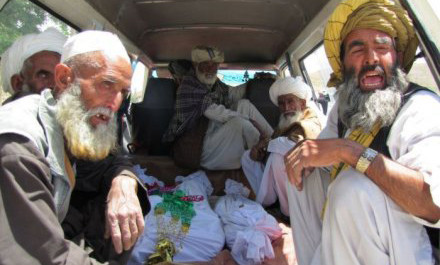
June 6, 2012: Afghan villagers with the bodies of children reportedly killed in a NATO air strike. (Photo: Sabawoon Amarkhil/AFP) BBC news
For U.S. citizens, Afghanistan flip flops between being the forgotten war -- during the invasion and occupation of Iraq, for instance -- to being the "smart" war with lots of rah rah around surges, signature strikes with drones, and faux "progress" for security. And for women. Lots and lots of progress for women and girls, if you believe NATO and the U.S. State Department's official pronouncements on the matter.

I spent many hours last week with people who feel, as I do, that U.S. presence in Afghanistan is a festering sore at the heart of that post-9/11 disease, the war on terror. We were looking into what evidence there is for progress, or the lack thereof, for women's rights, health and prosperity. 

(It is hard to use the word prosperity right now because the vast majority of Afghans are extremely poor. The children collect scraps of plastic to burn for cooking. The average life expectancy is 48 years for all, 51 years for women. We are not talking here of the wealthy elites with millions in offshore bank accounts, or even holding citizenship in other countries, who are in Parliament and other branches of the national government. Whose daughters fly to Dubai to get their wedding make-up professionally done.)

On a June 27 conference call, we heard from some speakers who had been to Afghanistan multiple times in the past decade. Fahima Vorgetts of the Afghan Women's Fund shared her observations: 
  • Violence against women has escalated in the last two years. 
  • Women are attacked from 3 sides: by NATO, by insurgents, and by their own government which has many warlords in positions of authority, some with private militias.
  • There are now laws protecting women’s rights, but they are not implemented or respected.
  • There will likely be no meaningful withdrawal in 2014, because right now the U.S. military is buying large parcels of land and expanding construction of huge bases in various parts of the country e.g. a dining hall that will seat thousands. There are now 400 bases (my note: HOLY CRAP! JUST IN AFGHANISTAN?) but many of those will be turned over to the Afghan military.
Lots of contractors with big fat contracts paid by the American taxpayer will try to continue extracting wealth and keeping transport corridors open, no doubt. Worked splendidly in Iraq didn't it? Now the U.S. has Iran surrounded, and gives the appearance of beginning to circle in for the kill. Prize? Control of the Persian Gulf.
Source: http://www.oneangryman.com/ken/wp-content/uploads/2012/03/military-spending.jpg
Fahima's observations seemed to accord with the findings in “Progress for Afghan Women” a WAND webinar by David Cortright on June 27 in the area of rights for women:
  • De jure important legal & political rights are now guaranteed to women in Afghanistan, including 25% representation in Parliament.
  • Except: Taliban has regained control in some areas, and women's rights have suffered.
  • Also, the national govt is full of misogynist warlords.
This reminds me of reading descriptions of the Afghan police taking bribes, practicing extortion, and routinely brutalizing prisoners.  Lt. Col. Daniel Davis made a year long-study traveling in Afghanistan, interviewing and observing at multiple locations, hoping to conclude that the army and police were doing a credible job of security. Although it was his job to do so, he was unable to find evidence for this. Quite the contrary.

This makes me think, Is it any wonder women in Afghanistan are in jail for adultery after being raped? 

Rules of law is on paper only, was the consensus of all three sources.

Mariam Raqib, of Afghanistan Samsortya spoke on the conference call primarily of environmental degradation:
  • Sever negative impacts of landmines, IEDs, unexploded bombs from NATO, and the effects of aerial bombing that penetrated deep into the ground.
  • Miscarriages and birth defects are reported on the rise by women in eastern Afghanistan, possibly due to the type of weapons being used there.
    Crop dusting the poppies also poisons people. 
  • Poor record keeping and health research amid the ongoing disruption of civil society makes health issues hard to quantify or study systematically.
  • Children gather scraps of plastic from enormous trash heaps that are everywhere, and women burn plastic to cook food for their families -- a highly toxic health hazard.
  • Samsortya establishes tree nurseries to support reforestation due to dramatic loss of forests and orchards over 30+ years of war, and the resulting dust and lack of cooking fuel.

Yup, big progress for the environment after ten years "stewardship" by NATO, the biggest polluter on the planet.

There was some evidence for progress presented in Cortright's webinar. He said that education has been a huge priority of the Afghanistan government and of international donors.
  • 900,000 students enrolled in primary and secondary schools in 2002, all male
  • 8.4 million enrolled in 2012, 39 percent female
  • Possible because of $$ from World Bank, UN, donor states, and USAID.
I question the statistics for 2002, because to say that zero girls were being educated in school in 2002 is implausible. Schools during the Taliban era were held in households secretly so they could appear to be doing something else if militants arrived. People never stop trying to educate their children. Again, nearly impossible to quantify, because of the continuous disruptions of war.

There were no sources on the slides, but David mentioned a recent major national health survey conducted with rigorous scientific methodology, which seemed to him to be the most reliable current source. He noted that most statistics on public health in Afghanistan are irregular, coming from various sources.
  • There are now 22,000 trained healthcare workers, including 3,275+ trained midwives. Skilled birth attendance now is at 34 percent, up from 14 percent
  • Child mortality has been cut by half, and there are 1 in 50 maternity deaths, a decrease.
  
In economics, a so-called National Solidarity Program offers microfunding to local Community Development Councils, has 35% female participation. 

(Smell the whiff of World Bank there? If you can't get on the gravy train of taking protection money for not attacking NATO supply convoys, maybe you can get credit to start a bakery.)

David's outlook on security were as dismal as the other experts: Leaders say it is improving, but the facts are to the contrary. He estimated insurgents number around 20,000. He noted that Gen. Petraeus stated in 2010: We're facing an industrial strength insurgency – there is no win here on a military basis.  

Cortright's own conclusions: The longer we pursue this war the more it seems to strengthen the insurgency. As long as foreign forces are in Afghanistan, this provides a boost to the insurgents. Women told us: it's the presence of foreign forces that is one of the driving forces in the insurgency.

And if that weren't enough to keep the longest war in U.S. history going, I bet we could pledge to hang in there in an "advisory" capacity until Afghan women finally get their rights. Which at this rate could take another 1,000 years.

Besides, if women got their rights, and sat down at the tables where peace treaties and post-hostilities are hammered out, the chances of war continuing would decline drastically. That's why the United Nations Security Council passed Resolution 1325, based on studies of conflicts around the world, in which it called for full participation by women in peace talks and negotiations. 

Like the rights of Afghan women, UNSC Res. 1325 remains, at this point in time, empty words on paper.

Thursday, June 21, 2012

In 10 years security conditions have worsened for Afghan women


Tree nursery worker, Surkhrud --  Source: AfghanistanSamsortya.org
by Dr. Mariam Raqib 
Dr. Raqib's work conducting forest and orchard restoration projects as director of Afghanistan Samsortya took her to Kabul, Jalalabad and Surkhrud during Sep.-Nov., 2011. During the trip she also interviewed clients of the Afghanistan Women's Council, which provides basic goods and training to people around the country, including in Ningrahar province where she interviewed villagers.

Women in Afghanistan are concerned with issues that are universal in nature. They want their basic needs and the basic needs of their loved ones satisfied. Food, shelter, clothing, security, and the freedom to be mobile are of primary importance. They want to feel safe, they want to feed their children, provide them with medication, and send them to school. But Afghan women are not in control of their destinies; others – the Taliban, NATO, the U.S., and other international aid agencies -- are self appointed guardians, and advocates of women.

Health indicators are dismal. Life expectancy for men is 49 and for women 51 years. According to UNICEF, 68% of children under five suffer from either stunting or wasting due to malnutrition. One in five children die before their fifth birthday. Access to clean water is very limited.

Literacy rates are among the lowest in the world, 28% overall and 13% for women. This is closely related to lack of security and safety in the country. Yes, there are schools. But where is the security to leave the house to go to those schools? Many schools also existed during the time Afghanistan was ruled by the Taliban also, but in secret. What keeps people at home not going to school? Lawlessness, gender related violence, threats from fundamentalist elements, including the Taliban and Northern Alliance gangs and militias, suicide bombings, land mines, and bombings by foreign militaries prevail and continue to threaten the population.

PTSD is not a disease that exclusively plagues soldiers. Women complain of extreme levels of stress regarding uncertainty in their lives and in the lives of their family members. They fear for their children, husbands, fathers, sons and brothers. They are not safe from atrocities from the Taliban, nor from the occupiers.

House to house searches are brutal, dehumanizing, and they instill fear in the population, including young children. Soldiers break into homes in the middle of the night, yelling and screaming obscenities at the residents, separating fathers from their children. The children are traumatized as they watch the soldiers rummage through their belongings, breaking things, disregarding the impact on the people.

Other hardships regarding women include cooking food using plastics, like bits of old slippers and other items that children collect from trash piles. While cooking they inhale the poisonous smoke, and which also contaminates the food. Lack of wood and fuel can be addressed, and in fact, an inspiration for establishing Samsortya's tree nurseries was when I witnessed women cooking in such conditions.

Women report having miscarriages at high rates, and this is likely connected with both pollution and the use of various weapons such as depleted uranium. I was told of fetuses with such strange defects that they are unrecognizable as human. In addition, people say Afghans are dying of cancer at a much higher rate than before. Sadly, there is very little documentation – scientific, or otherwise -- regarding these tragedies, due to the disruptions of war.

One of the worst effects of the war for women and everyone is pollution. Dust fills the air all the time because of the lack of trees and bushes. But even worse is the noise pollution. For example, drones make a very penetrating noise that goes on and on.

Helicopters make an enormous roar traveling in pairs. Helicopters, because the elites do not travel by roads, they go by air. They are especially large and very dark, like vultures. Also there is the noise of tanks and trucks rumbling by, which rattles the buildings you are in. Lines of sand colored trucks as big as a room go by, with modern day cannons on top. The soldiers have on helmets and body armor, but one can still sense their fear. Something about the posture. Everywhere is tense.

Now women do not feel safe leaving the house, and if they do leave the house, they don't feel safe without wearing the burqa. Even in Kabul this is now the case. My friend and I went to meet a woman from the U.S. State Department and she said to my friend, “Why do you wear the burqa? Why not be modern?” She had no idea how bad the security situation is for women in Afghanistan.

Bottom line on whether women have made progress under NATO? The United States is in Afghanistan to promote its own policies, and establish military bases from which they can control Asia. Afghan women, and children are not of any concern. They are used as political tools to pacify and, even more importantly, to deceive the American public.

The United States has done a fantastic job of building alliances with warlords, purchasing them with money and using them as proxies. In ten years security conditions have not improved and have, in some cases, even worsened for women.
---

Dr. Mariam Raqib conducted research trips to Afghanistan over six years of graduate studies in Political Science at Northeastern University, 2005-2011. She is working on a book about the success of the Taliban movement in using religious symbolism to channel the frustrations of a grieving population.

Friday, October 22, 2010

Convergence of CODEPINK women

Gaza boys pulling barbed wire

Codepink women braved blustery weather on a spectacular fall day to converge last weekend, share their stories, and witness the amazing work women are doing all over the world.

Ridgely Fuller was our hostess and she shared photos from Gaza and the West Bank. Here we see Palestinian boys using large rubber straps to pull back the barbed wire that Israel's government uses to keep them from their agricultural lands. (Apparently these IDF soldiers did not have scissors or anything to cut the rubber bands with in this photo.) On her trip in August she worked with children suffering from PTSD using an innovative therapy that combines physical movement with brain patterning. Ridgely has been traveling around New England giving talks about facts on the ground in Palestine, and had just shared the podium with Noam Chomsky last week. We all appreciated hearing from her.

Here are more photos from our day: http://www.flickr.com/photos/codepinkalert/sets/72157625181173394/

Mariam Raqib gave a compelling presentation and news of the growth of her Afghanistan Samsortya tree project (link here).  Successful drilling of a well means that five drought resistant, fast-growing species of trees are being nurtured, including the “magic” tree Moringa oleifera, whose leaves can be food for both animals and people, supporting lactation. Samsortya is a community project thriving on cooperation between agricultural workers in Surkhrud, Afghanistan,  and organizers and fundraisers in the New England region. It will soon receive another donation of seeds from the New Forests Project World Seed Program.


This convergence was only possible because of the organizing energy of Cat Erdman, and the time and energy shared by all the wonderful women who came.

Saturday, October 16, 2010

Women's work


"The U.S. Air Force has dropped 700 bombs on the people of Afghanistan in September alone. They have dropped more 2,000 bombs on the country since July. The Pentagon has also carried out a record 21,000 unmanned drone sorties in Pakistan and Afghanistan so far in 2010." from a letter by Brian Becker, ANSWER, 10/15/10
Today CODEPINK Maine has organized a mini-retreat, a convergence event for women to get together on an island in Maine to grieve, to report out, and to share our commitment to work for peace and justice.

We'll be hearing from Mariam Raqib about her excellent tree reforestation project in Afghanistan, Samsortya. She'll also be sharing the grave concerns of her family and the villagers who care for the trees, about what lies ahead for Afghanistan.

Ridgely Fuller and Carolyn Coe will bring us news from Gaza, the western end of the war torn Middle East region being plundered by bullies. Gaza is commonly referred to as the largest open air prison in the world, where the collective punishment of 1.5 million people continues, funded by both Israeli and U.S. taxpayers. Activists in our region are fundraising for clean water for kindergartens there, mental health services for Gazans, and relief efforts like U.S. Boat to Gaza. The Israeli "Defense" Force continues to stop humanitarian workers in international waters and confiscate their supplies: medicine, building materials, toys and the like. Reports are they will use dogs on the next boat that tries to get through the blockade.

In such troubled times it helps to listen hard for the voices of sanity. When indigenous people got together in Cochabamba, Bolivia to discuss the distress of our Mother Earth, laboring to bring forth life as death rains down from the skies, they produced a statement. Six months ago delegates to the World People's Conference on Climate Change and the Rights of Mother Earth and signed a People's Agreement that begins like this: "Today, our Mother Earth is wounded and the future of humanity is in danger." It goes on to list some of the issues, and has a statement of rights for the life producing system that is our planetary home:
  • The right to live and to exist;
  • The right to be respected;
  • The right to regenerate its bio-capacity and to continue it’s vital cycles and processes free of human alteration;
  • The right to maintain their identity and integrity as differentiated beings, self-regulated and interrelated;
  • The right to water as the source of life;
  • The right to clean air;
  • The right to comprehensive health;
  • The right to be free of contamination and pollution, free of toxic and radioactive waste;
  • The right to be free of alterations or modifications of it’s genetic structure in a manner that threatens it’s integrity or vital and healthy functioning;
  • The right to prompt and full restoration for violations to the rights acknowledged in this Declaration caused by human activities.

Today we women in Maine are exercising our right to gather for support and renewal. We are now the grandmothers of our troubled world. We come together in the kind of circle that indigenous people have always held when faced with crisis. We will hold Mother Earth and her children in our hearts.

Friday, July 30, 2010

Hope and Despair

New trees growing in Surkhrud, Afghanistan

Yesterday I heard that one of our best programs for helping high school students reach college and succeed there had huge cuts in funding. Upward Bound has been very successful with students I know, kids from families with one struggling single parent who works a lot, families in which no one has gone on to college yet.

During the summer, students who are accepted in the program spend several weeks living in a dorm at our local state university campus. They take classes on topics like how to write an essay or ace the SAT, and they work at part-time jobs (for pay) that connect to an interest area – hospital for those who intend to go into health care, etc. They go on outings to climb mountains and such. Last year they met after school once a month with their very fine mentor Elyse Pratt-Ronco who brought snacks and gave seminars in how to identify what you are really interested in, or how to get your scholarship applications in on time. The bulletin board they created to promote Upward Bound showed how much they love the program and the many ways it meets their needs.

A senior in a nearby school district has been in the program for three years. Her mom told me yesterday she could not afford the fees being charged this summer to make up for the budget cuts, so her daughter stayed home instead and looked for a job to save money for college. She hasn't found one yet.

Senator Susan Collins and Senator Olympia Snowe have shamed themselves by voting to borrow $37.12 billion for more war for oil in the Middle East. One minute of war in Afghanistan would have paid for forty kids to attend Upward Bound! NY Times columnist Nicholas Kristof wrote this week of "a sobering report from the College Board says that the United States, which used to lead the world in the proportion of young people with college degrees, has dropped to 12th."

Experts agree that Maine will never climb out of the economic doldrums we seem permanently stuck in without a more educated population. Of course those who do earn a college degree seldom return to live in my area, because there are no jobs here. How many jobs could be created next year with $37.12 billion?

My friend Mariam Raqib sent me hopeful news last week. Her project to help local people replant trees in Surkrhud District near Jalalabad City in eastern Afghanistan is thriving.

Afghanistan Samsortya (which means “re-vitalization”) has established nurseries for five drought resistant, fast-growing species of trees using seeds from the the New Forests Project World Seed Program.

One species, Moringa oleifera, is called “the magic tree” because its leaves can be food for both animals and people, and especially support lactation. According to the Samsortya website, “60-80% of trees in Afghanistan have been destroyed over the last thirty years. This affects not only people in Afghanistan, but people everywhere who share our global environment.” No kidding.

Fundraising to re-establish a viable irrigation system is ongoing. You can contribute to the project, and help grow some hope.