Showing posts with label Academy Awards. Show all posts

Monday, March 10, 2025

If 'Dear Child' By Chris Hedges Were Lip-synched At The Oscars


Source: Al Jazeera


As Gaza descends into darkness with electricity cut off and with no aid trucks entering since March 2, I want to share this fascinating lip synch by Palestinian/Lebanese drag artist Indie Nile. They perform Chris Hedges' moving piece "Dear Child" stemming from Hedges' plans to gather in Egypt at the Rafah crossing with other journalists banned from entering to witness Israel's genocide.

Nile performs this piece in the guise of an Oscars acceptance speech -- you don't want to miss it.

I've cued the Youtube video to start from the lip synch, which is actually at the end of his whole post. All of it is worth watching.


Link to video if the embed does not work for you.


Wednesday, March 5, 2025

Film Review: NO OTHER LAND


Critical analysis aside, the fact that Palestinian documentary NO OTHER LAND won an Oscar for Best Documentary in the bastion of Zionism that is Hollywood is huge. Or maybe I should say that the Academy of Motion Picture Arts used to be a bastion of Zionism? Maybe this win can be seen as a generational shift analogous to that of younger Jews moving away from unconditional support for the U.S.-Israel land theft enabled by genocide.

I saw the film yesterday at the Strand Theatre in Rockland, Maine (it will show again tonight, March 5, at 7pm). It called to mind another documentary about the challenges of documenting land theft actions by Israel's military and settler militias, FIVE BROKEN CAMERAS. Masafer Yatta and Bil'in are different locations, but both are in the occupied West Bank and constantly besieged by violent Zionists. CAMERAS was released in 2011; more than a decade later, not much has changed.

Student of law Basel Adra operates his family's gas station following his father's arrest and imprisonment in notorious torture site Ofer Prison. He puts aside his camera and explains to his partner in documentary journalism, Israeli Yuval Abraham, that he needs to provide for his family. While Abraham moves at will on special roads for cars with yellow i.e. Israeli license plates, Adra and his neighbors are constrained at every turn: checkpoints, home and school demolitions, stun grenades and live ammunition. 


The Maine audience gasped as Israeli soldiers poured concrete into a well, and when soldiers shot young Harun abu Amar as he struggled to prevent them stealing a generator. Amar's subsequent paralysis and suffering, in a filthy cave rather than in a now-demolished home, and his mother's anguish over caring for him and her wish that he could die, are fierce. (A footnote at the end of the film says he did die, and I imagine I wasn't the only one who muttered Thank God.)

The fact that Amar is visited by a host of foreign journalists and filmed even as he tells them he doesn't consent and that they should go away teases out the film's central theme: what good does documenting atrocities do if atrocities continue accelerating? The problem of finding an audience is discussed in terms of likes on social media or online publications. Adra asks Abraham if there is much interest in his articles among Israelis. There isn't.

A visit by the odious warmonger Tony Blair does little to remedy this, though appears to result in some temporary and limited relief from land theft.

A question I had going in: does this film subtly promote the Zionist project in Palestine? A friend had shared a post on the blog Marginalia Subversiva, "The Celebration of a Sanitized Narrative: How Genocide is Managed, Marketed, and Sanitized" An excerpt:

The Oscar win for No Other Land has been hailed as a historic moment for Palestinian representation in cinema. But beneath the surface of this celebration lies a deeply frustrating reality: Palestinian stories are only recognized when they fit a settler-approved narrative -- one that erases Gaza, centers Israeli voices, and reinforces the colonial fantasy of a "two-state solution."

The post linked to a scathing review by Mary Turfah, "'No Other Land' For Whom?" on the film website mubi.com. "The Palestinian-Israeli documentary indulges in a familiar kind of wishful thinking" is its subtitle and Turfah goes on to say:

Abraham remains committed to ending the program of ethnic cleansing committed in his name, but in the film and elsewhere, he attributes those horrors to the “occupation” rather than to Zionism. His condemnation of the former serves to preserve the latter. This distinction is artificial: from the standpoint of its victims, Israel is its occupation, the Zionist project necessarily one of ethnic cleansing and genocide, of total erasure.

Abraham attempts a rehabilitation of an iteration of Zionism that doesn’t exist but could, a familiar settler hope (think, imagine what America could be). 


Young children crying in fear as a contingent of Israeli soldiers in combat gear looms outside the windows of their village school made me cry, too. The villagers struggle to defend the school they've built, but the occupation's bulldozer crushes it anyway. Adults comfort the children sometimes with white lies like Don't worry, you are safe and It will be ok. What else is a parent to tell them?

There is no happy ending where the children are safe. In his Oscar acceptance speech Adra invoked his infant daughter, but at the end of LAND he answered Abraham's question about his desire for marriage and children by saying that without stability "it's complicated." Filming in Masafer Yatta occurred prior to Hamas' Gaza Al-Aqsa Flood operation October 7, 2023 but the final cut includes an audio clip of an English language broadcaster repeating PM Netanyahu's lie about Hamas killing thousands of Israelis that day. That lie goes unchallenged in the film.

On our way home I asked my husband to imagine being a 12 year old who didn't know about the Zionist occupation of Palestine. How would the film seem to someone without much background information? Mark said: I don't think anyone could see this evidence of Israel's sadistic cruelty without siding with the Palestinians. My conclusion: the film is imperfect, but the Oscar win is a good thing in terms of showing how land theft by Israel is ongoing and actually has nothing to do with Hamas. And, as Turfah observes, demonstrating the need for armed resistance. No wonder it has not found a U.S. distributor!

Of course my husband had plenty of background information heading into the film. As we rose from our seats he turned to me and said, Fuck Joe Biden. I would add Fuck 47, too. They both have the blood of tens of thousands of Palestinians on their hands.


If you live in the U.S. and want to send yet another message to your AIPAC-sponsored members of Congress, you can click here.


REVISED March 7: Revised to include this link to the Palestinian Campaign for the Academic and Cultural Boycott of Israel’s March 5 statement on NO OTHER LAND.

REVISED March 8: Revised to include this link to Indie Nile’s video review of the film highlighting the normalization aspect of NO OTHER LAND.

Monday, March 3, 2025

Ken Jones: Slow Motion Ethnic Cleansing In Hebron

Photo from West Bank land theft documentary NO OTHER LAND which won an Oscar last night (if you're in the UK, watch it streaming at Channel 4).

Reposting this piece from Counterpunch by a friend who just returned from the West Bank. 

Slow Motion Ethnic Cleansing in Hebron

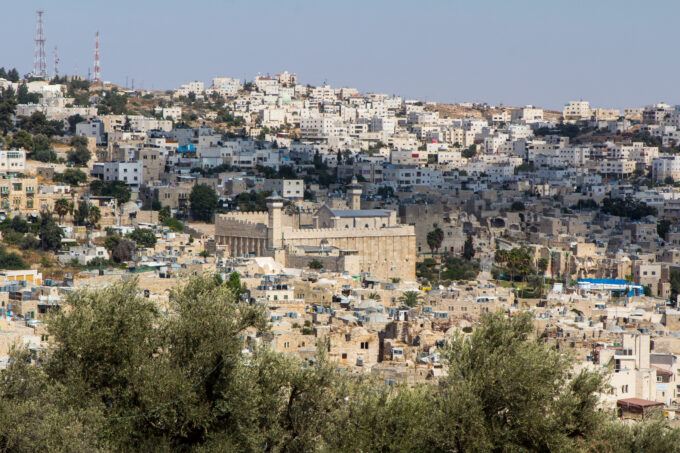
Photograph Source: Oren Rozen – Own work – CC BY-SA 4.0

“Tell our story!” the man in the checkpoint cage yelled, in English. He and a crowd of Palestinian Muslim men were jammed together waiting to be checked out, one at a time, by an Israeli soldier in a glass booth so they could go into Hebron’s Ibrahimi Mosque to pray. Such daily and routine humiliation is the hallmark of the Israeli occupation.

I was in Hebron (Al-Khalil) for two weeks recently as part of a Community Peacemaker Team (CPT) delegation. Every day, we accompanied or heard testimony from people living there who were living under the guns of the Israeli Occupation Forces (IOF) and the aggressive hostility of the 800 settlers who claim that the city of 200,000 was given to them by their god. Every night, I kept a blog trying to capture one of the many stories we heard of the oppression.

Hebron is in the southern part of the West Bank. It hasn’t gotten the genocidal Gaza treatment that Jenin, Tulkarem, and Nur Shams are now getting. But, as someone said to me, “We are waiting our turn.” It may be that the tanks and bombs will come to Hebron too, but at the moment, what is happening there is the decades-long grind of military occupation and settler colonialism.

The stories we heard are gruesome. And everyone has one. Most men have been taken to prison and tortured. It’s common to have your home broken into in the middle of the night by soldiers who yell, beat everyone, and kidnap fathers, sons and daughters, taking them away to unknown locations, with no charges, and for an undetermined time. Entire homes are demolished regularly. Land is stolen. Movement is restricted. Surveillance is constant and pervasive. These stories don’t make the news. They have become too normalized.

Here are a couple of stories that may give a glimpse of what daily life is like in Hebron.

One day, a 20 year old woman told us about her year in prison. She recounted the horribly dirty and crowded conditions, the scarcity and bad quality of the food, the strip searches, the beatings, the constant verbal abuse.

She said the hardest thing that she witnessed was when women from Gaza were brought in. They wore bloody clothes and their hijabs had been stripped away from them. They were given no beds, nothing to clean themselves with. They were given dirty clothes that had been deliberately contaminated with lice. When they went to the bathroom, they were taken by male soldiers.

Then she told us the story of Oct 7, 2024, the one year memorial” of the Gazan attack on Israelis. An officer entered womens rooms and gave them 30 seconds to cover themselves before soldiers came in. When the soldiers came, they put zip ties on the womens hands, blindfolded them, and took them out. They made them lie face down on muddy ground, beat them, cursed hatefully at them, and brought police dogs out to terrorize them. While this was going on, soldiers went into their cells, took all of their clothes, and set off tear gas grenades in their cells. Then they put the women back in their cells.

On another day, an older man who was living in a family home handed down through generations told us of the daily harassment he has been subjected to by settlers living next to his house. Protected by the IOF, they are taking pieces of his land every day. They have poisoned his sheep, stolen his olives, and destroyed over 250 olive trees.

His home is frequently used for family gatherings. During one of these recent gatherings, a large group of settlers burst into the house and started assaulting people. Some of them were dressed as soldiers. There were many injuries, windows were broken, and cars damaged. Then they stopped an ambulance from getting to the house.

Settlers have attacked his family in the fields and farm with stones, have brandished guns, and beaten them with sticks. They have driven jeeps right into the house, dumped bulldozers full of trash at their front door. Soldiers have tear gassed the inside of their home and flown drones overhead frequently.

The story we heard at the village of Um Al-Khair in the South Hebron Hills is emblematic of what is happening  all over the West Bank. The village consists largely of descendants of refugees from the 1948 Nakba.

Immediately next to the village is a settlement of some 500 Israeli families and nearby, a military base. The teens from the settlement act as front-line vigilantes. They roam around with sticks and pepper spray making life miserable and tense for the people of the village. They have broken into homes and beaten women, damaged the village water pump, and even herded sheep right into village homes.

Whenever the villagers complain to the police about such attacks, the police say they have been told by the settlers that the teens are being attacked by the Palestinians. The police threaten to arrest the villagers if they keep making these calls.

We were walked to a recently demolished house where a couple of young Palestinian men were sitting, looking sadly at the ruins. Three rooms and a water tank were all jumbled up in piles. One of the men told us his 60-year old mother, who owned the house, had been thrown to the ground when she yelled about her house being destroyed. There was nothing the son or mother could do about it. Their family is now crowded in with a next door neighbor. In June, Israel had demolished 10 homes in one morning in the village.

We were told that Israeli law forbids people from rebuilding a demolished home in the same site. There is, in fact, a settler organization in Israel named Regavin that flies drones over newly demolished homes to report to the military any Palestinian attempt to rebuild. Still, the son and villagers are planning to rebuild the home.

Our village guide talked about the trauma of it all, especially for the kids. He said, It is very hard for us to live in this condition. These people are not neighbors, they dont care about us at all. They treat their dogs better than they treat us.” He worried about the mental health of his five young daughters and all of his friends living there.

We walked down to the paved road that was put in for the settlement. It was put over a dirt road that had been there since Jordan controlled this territory many years ago. Israel now defined the paved road as the border of the village, beyond which they and their goats and sheep were not allowed to trespass.” Simple as that, their pasture land was stolen. Soldiers also put a gate at the beginning of the road so that they can close off entry and exit into the village whenever they choose.

We walked past some sapling trees, supplied by the Jewish National Fund, that settlers had just planted right next to villagers’ houses. The obvious purpose of planting the trees was to establish a claim to the land.

We saw the electric lines leading to the settlement. The villagers cant use that electricity. They have power only from a small number of solar panels. We also saw the now repaired water pump from which they are allowed to draw from only 2 days a week, for a total of 6 hours. We saw the surveillance camera up on a pole overlooking the village. They are watching us all the time,” our guide said.

We were told about the sounds of gunfire from the military firing range that was put illegally on their land. I imagined how threatening that must be, especially for the children.

All of this pressure in Um Al-Khair is one big systematic slow motion ethnic cleansing campaign, designed to push the villagers off their land. The intention is not just to demolish homes, land rights, and mental health. Its meant to demolish hope.

But from what I could see, Palestinians will never give up hope. Every story of injustice we heard was told with a spirit of determined resilience and resistance – sumud, as it is called there. No Palestinian we met was planning to leave or submit. Everyone appeared to be carrying on with life, with joy and humor, and with healthy relationships, despite the danger and indignities they were suffering. They refuse to live in fear. As one person said, “Thats what they want, for us to be afraid. They want us to leave. We will not fear and we will stay until this occupation is over.”

As has often happened to me when I visit places that are on the receiving side of U.S.-sponsored violence and oppression, I was struck during this visit by the strong and enviable character of the Palestinians we met. They are not defeated, their spirits are not broken. They are warm, generous, dignified. I always felt safe and cared for around them, even though I, as an American, had no right to expect such treatment. The only times I felt fear and coldness were when I was around Israeli soldiers or settlers. That’s telling.

The stories and voices of Palestinians have always been purposefully suppressed by the powers that be in the U.S. and the West. As has the truth about how Palestinians have been treated for over a hundred years. The genocide in Gaza has burst that bubble of shadows and lies and revealed the ugly truth of the Zionist project all over Palestine. It is a cancer.

Hebron is still a vibrant place, bustling with life. May its countless stories be heard, may its occupation end, may its people be free. And the same for all of Palestine.