|
| Photo by Ellen Davidson of Father Mun surrounded by police outside the navy base construction site on Jeju Island |
I was particularly struck by the efforts of corporation Samsung to collectively punish a village fighting to preserve natural resources and their traditional fisheries from destruction by militarization. It reminded me of the Trans Pacific Trade treaty (TPP) which, if adopted, would allow corporations to punish anyone interfering with their "right" to profit.
 |
| Photo by Dud Hendrick |
Friends,
Unbelievably, we're on our last day here in Gangjeong Village on Jeju Island, Korea. It has been an emotional five days, as we have been given a crash course on the crime being perpetrated on this coastal community. The completion of the base is nearly a fait accompli--the government is projecting that it will be completed in the coming year. Having been here in April of 2013 and remembering the status of the base then has made this visit all the more disturbing--at the same time it has been uplifting.
The protest has been continuing virtually non-stop for over 8 years, testimony to the depth of the passions the base has ignited. During my first visit it was already clear that it would take a miraculous turn of events to stop the project. Then I was impressed by the resolute dedication of the protesters; a conglomeration of Gangjeong villagers at the helm along with other Jeju islanders, mainland Koreans, and international activists. The resolve now goes way beyond "impressive." One observation is that the leadership, a diverse array of characters, seems to have remained stable. Many of those who played critical roles in 2013 and prior---even going back to 2008--continue to do so. The rank and file come and go, but many, particularly the young, have stayed for years.
Photo of VFP delegation, provided by Dud Hendrick (front row, on right)

Others, like a few in our 13-person delegation have returned several times--the most notable being Bruce Gagnon who you might say has been adopted by the village and Ann Wright, the famed peace activist and former U.S. Army colonel and foreign service diplomat who resigned her position in opposition to the Iraq war. Bruce is deserving of the village's high regard that he is accorded--having visited five times and being, probably, the single person whose work has most brought Gangjeong to the world's attention. (My note: you can read Bruce's report back here.)
An ironic twist--Samsung, the primary contractor on the project is attempting impose a hefty fine on the village of Gangjeong in penalty for all the delays caused by the protests.
During our visit we have been honored to have received briefings from some of the prominent leaders who have provided the inspiration behind this enduring resistance:
Photo by Dud Hendrick of Ann Wright of Veterans for Peace with Father Mun Jeong Hyeon of the Catholic Church Solidarity to Make Peace on Jeju Island
Father Mun Jeong Hyeon, the iconic leader of the protest, was awarded the 2012 Gwangju Prize for Human Rights. The founder of Catholic Priests' Organization for Justice in opposition to South Korean dictatorships, he conducts the daily mass at the naval base gate and is generally the point person in protest from dawn 'til dusk. He has been a leading voice against the U.S. military presence in Korea for decades.

Father Mun contributed his $50,000 Gwangju (cash) Prize to the anti-naval base campaign. He is a strong proponent of reunification between North and South Korea and sees the U.S. as the primary obstacle preventing that dream, embraced by many Koreans, from becoming reality.
You can read more on how to support the struggle to save Jeju Island from U.S. Navy destroyers and other warships here on the website Save Jeju Now.
The base is intended for warships such as the Zumwalt built in Maine at Bath Iron Works by General Dynamics; here, the Kennebec River ecosystem is disturbed by dredging so that the highly profitable ships can be moved out to sea and then to Jeju Island where a soft coral reef has been entombed in concrete to make a port for them.
How many public housing units could we have built with the money we spent on this thing?
Posted by Asher Platts on Thursday, December 10, 2015
Asher Platts, Managing Director of the Green Shadow Cabinet, posted this recent video of a $4 billion weapon of mass destruction moving through Portland's Casco Bay with the comment, "How many public housing units could we have built with the money we spent on this thing?"
Jeju Islanders recently heard bad news that the government also has plans to build an airport on their island, in an area considered sacred to agriculture. As reported by Sunny on the Save Jeju Island website: "This revelation came as a huge shocker for the Jeju Islanders, who had no say in the decision-making process."
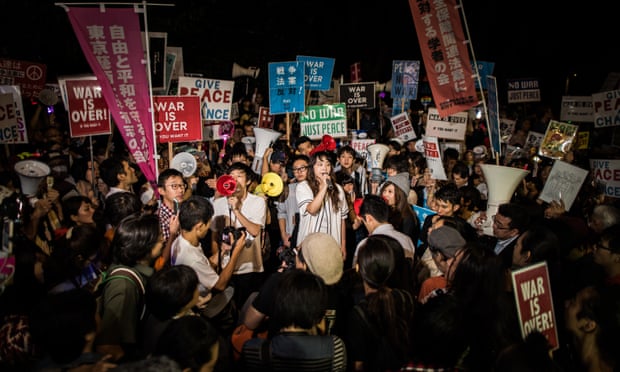
South Korea's right-wing government, a close ally of the U.S., recently tried unsuccessfully to ban all demonstrations in order to suppress a growing mobilization of farmers, labor unions, and students on the mainland. Some responded to the government's ban on masks at demonstrations by making up as clowns and marching anyway on December 5 in Seoul.
What connects all this news is the theme of governments who represent corporate profits rather than their people. Democracy is a sham under such a system, and the police enforce corporate agendas rather than serving the public. Politicians in Maine like to call such arrangements "public-private partnerships" but fascism is more concise and accurate, and I know we must resist while we are still able. As Bruce Gagnon puts it, "Rattle your chains!"