 |
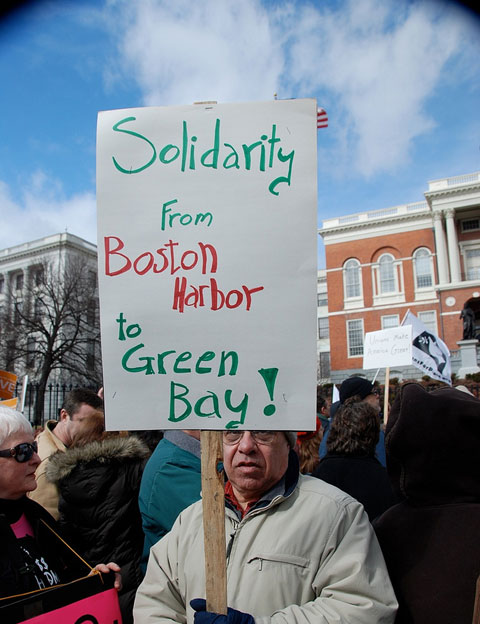
| Sarah Roche-Mahdi of Codepink Greater Boston at the State House steps in Boston Feb 26 in a BOW$H t-shirt w/ sign: Worker's Rights are Human Rights. See her in action this Sat March 5 same place 1-3pm for International Women's Day rally to Bring Our War $$ Home. |
I invited the Maine affiliates of US Labor Against the War to join us in Augusta on Mon April 4 for a new conference calling on leaders to stop spending on wars in order to avoid budget cuts at home. A week later, I've had no reply. Is US organized labor so short sighted that they would rather bury their heads in the sand and continue supporting jobs programs at any price, including building weapons systems that kill workers in other parts of the world? I hope not. The time will soon come for us all to decide.
Open letter to Maine labor leaders inviting them to join us at the podium in the Hall of Flags on April 4:
The BOW$H coalition is working to connect the dots between draconian measures against working people's jobs and benefits, including pensions -- an attack which threatens even the right to collective bargaining -- and the vast amount of federal income tax money spent on wars. This includes enormous sums the Pentagon pays to private contractors, to dictators, and to extremist groups like the Taliban, among others, with little oversight into where the money actually goes.
The fact that military spending also supports a large number of full benefit union jobs is Maine is an important consideration.
We do not support throwing people out of work via cuts in military spending; we support full commitment to conversion of our industrial capacity to manufacture badly needed infrastructure. Below is a photograph of a chart I prepared for our BOW$H new conference on MLK Day in 2010. It shows in graphic form the number of jobs generated by a $1 billion investment in various sectors of our economy. Building weapon systems generates fewer jobs than building light rail or home construction elements, for example.
Data source: Robert Pollin and Heidi Garrett-Peltier, Department of Economics and Political Economy Research Institute
University of Massachusetts, Amherst The U.S. Employment Effects of Military and Domestic Spending Priorities.
On numerous occasions we have lobbied our representatives in the House about the need to look to the future in creating sustainable jobs in Maine. Their recent votes on military funding indicate they are hearing this message from a broad range of constituents.
I believe Maine could lead the way nationally in converting our factories, if the workers of Maine organized in solidarity on behalf of our common best interests.
The events of April 4 will also include our 2nd Draw-in throughout the day with the Union of Maine Visual Artists. Artists will be on hand to draw how the people want to see public funds spent, and we invite participation from all Maine's working people in helping to envision a better future.
Lisa Savage
CODEPINK Maine Local Coordinator
Maine Education Assn. member 1994-present

 |
| Both CODEPINK Greater Boston and CP Maine now have a set of these awesome pink parasols. Invite us to your event! |


